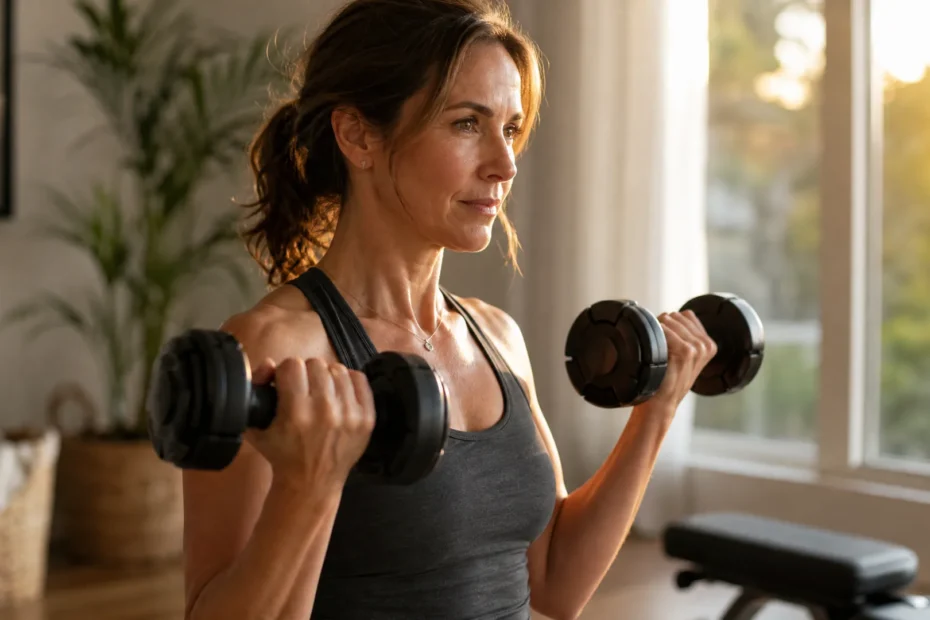
Turning 40 changes your body’s rules, whether you’ve noticed yet or not. Muscle doesn’t hold on the way it used to. Recovery takes longer. And most fitness advice still points you toward a gym membership or a supplement stack instead of addressing what’s actually happening hormonally. This guide takes a different approach. It’s built around strength training at home for women over 40, with the hormonal, bone health and recovery factors that generic workout content skips over.
Why Strength Training at Home for Women Over 40 Matters Now
You don’t need a gym to build real strength after 40. You need a plan that respects what your body is going through and adapts as you go. That’s the gap this guide fills.
What Changes Hormonally After 40
From your early 40s, oestrogen and progesterone start to fluctuate more than they used to. This is the beginning of perimenopause for many women, even before periods become irregular.
These hormonal shifts affect more than mood and hot flushes. They shape how easily you build and keep muscle, how your body stores fat, and how well you sleep and recover between sessions.
The Link Between Muscle, Metabolism and Ageing Well
Muscle mass and bone density both tend to decline more noticeably from the 40s onward, particularly as oestrogen levels shift during perimenopause. That’s why resistance training comes up so often as a key countermeasure.
Less muscle means a slower metabolism, less strength for everyday tasks, and higher injury risk. Strength training pushes back against all three. It’s one of the few things that works on ageing itself, not just on how you look.
Hormonal Changes and Perimenopause Fitness: What to Expect
Perimenopause fitness is a growing conversation across Australia. More women are asking how to train smart through this stage, not just push through it.
How Perimenopause Affects Energy and Recovery
Fluctuating oestrogen and progesterone can disrupt sleep, raise stress hormones and leave you more fatigued than usual. Some weeks you’ll feel strong and motivated. Other weeks the same workout will feel twice as hard.
That’s not a sign you’re doing something wrong. It’s a normal part of how your body responds during this transition. Recovery between sessions may also take a little longer, so rest matters more than it did in your 20s or 30s.
Adjusting Training Around Your Cycle
Because energy and recovery shift week to week, flexible programming matters more than ever. Home-based training suits this life stage well. There’s no fixed class time to work around.
If you’re depleted, scale a session back. If you’re feeling strong, push a little harder. You can train around cycle changes, sleep-deprived nights or unpredictable symptoms without losing momentum or feeling like you’ve failed a program.
Protecting Bone Density With Resistance Training at Home
Bone health becomes a bigger priority from your 40s onward. The good news: you can support it without a single piece of gym equipment.
Why Weight-Bearing Exercise Matters After 40
Bones respond to load. When you place stress on them through weight-bearing and resistance exercise, they adapt by staying stronger. That’s a core part of general osteoporosis-prevention guidance, and it applies whether the load comes from a barbell or your own body weight.
Squats, lunges, step-ups and resistance band work all place useful load through your bones and joints. You don’t need heavy gym machines to get this benefit.
Safe Loading Principles for Beginners
Start light and build gradually. Good form matters more than heavy load, especially in the first few months of resistance training for women over 40 at home.
Focus on controlled movement, full range of motion, and progressing only when a movement feels solid. If you’re new to exercise or have a history of injury or low bone density, mobile exercise physiology support can help you build a program that loads your body safely from the start.
Progressive Overload at Home: Building Strength Without a Gym
You don’t need a rack of dumbbells to get progressively stronger. You need a plan that increases difficulty in small, sensible steps.
Bodyweight Strength Progressions for Women Over 40
Bodyweight strength for women over 40 builds effectively when you start simple and move up in stages. A sit-to-stand squat from a chair might progress to a bodyweight squat, then a split squat, then a single-leg squat as balance and strength improve.
Push-ups follow a similar path. Wall push-ups lead to incline push-ups on a bench, then full push-ups on the floor. Each step increases the load your muscles handle. That’s exactly what progressive overload means in practice.
For a full setup with no equipment at all, a beginner home workout routine with no equipment is a solid place to build your foundation before adding load.
Using Bands and Light Dumbbells Safely
Once bodyweight movements feel manageable, resistance bands and light dumbbells give you an easy way to keep progressing. Bands add tension through a movement without needing much storage space. Dumbbells let you increase load in small, controlled increments.
A woman over 40 returning to fitness might start with wall push-ups, sit-to-stand squats and resistance bands at home, then progress to free weights as strength and confidence build. That gradual build is far safer, and more sustainable, than jumping straight into heavy lifting.
Setting Realistic Goals for Home Fitness After 40
Home fitness for women 40 plus works best when your goals reflect what your body actually needs at this stage, not what a six-week transformation ad promises.
What Progress Actually Looks Like
Progress after 40 often shows up as function before it shows up in the mirror. You’ll notice you can carry the shopping in one trip, get off the floor without using your hands, or climb stairs without feeling your knees complain.
Strength gains, better sleep and steadier energy are all wins worth tracking. Aesthetic changes may follow, but they’re not the only measure that counts.
Common Mistakes That Stall Results
The most common mistake is doing too much too soon. A sudden jump from no exercise to daily intense sessions usually ends in burnout, injury or both.
Skipping recovery is another big one. Muscles adapt and grow stronger during rest, not just during the workout itself. Exercise physiologists and personal trainers commonly recommend resistance training two to three times a week as a foundation for maintaining muscle and bone health through midlife. Fewer, well-recovered sessions usually beat daily sessions done half-heartedly.
Inconsistent effort is the last major trap. Strength built at home comes from showing up regularly, not from occasional intense pushes followed by long gaps.
When to Work With a Personal Trainer Over 40
Training at home doesn’t mean training alone. A personal trainer over 40 can bring structure, safety and accountability to a program you’d otherwise be guessing your way through.
Signs You’d Benefit From Professional Guidance
If you’ve got an injury history, ongoing joint pain, or bone density concerns, professional input helps you load safely from day one. If perimenopause symptoms are making energy and motivation unpredictable, having someone adjust your plan session to session takes the guesswork off your plate.
If you keep starting programs and stopping within a few weeks, that’s usually a sign you need accountability, not more willpower.
What a Mobile Female Personal Trainer Can Offer
Fitness Inside Out has delivered mobile and online personal training across Sydney, Melbourne, Brisbane, Central Coast and Wollongong since 2001, including dedicated programs for women over 40 and over 50s. A female personal trainer over 40 in Australia through Fitness Inside Out brings your session to your home, at a time that suits your week, with a program built around your hormonal stage, injury history and goals.
This is the same idea behind the benefits of mobile personal training: great coaching should fit around your life, not the other way around. It’s especially useful if you’re juggling work and family, and it’s part of why so many training options for busy mums in Sydney start with an in-home session rather than a gym sign-up.
If you’re wondering how to keep training without ever stepping into a gym, how to stay fit without a gym membership covers that approach in more depth. And if you’re planning further ahead, training programs designed for women over 50 show how this kind of support can grow with you into the next decade. For a broader view of coaching through midlife and beyond, the complete guide to personal training for older adults is worth a read too.
Strength training at home for women over 40 works best with the right structure behind it. If you’d like help building a program around your body, your schedule and your goals, book a free consultation with a Fitness Inside Out mobile personal trainer. It’s a simple first step toward training that actually fits your life.