Starting an exercise habit doesn’t need a gym membership or a garage full of equipment. A well-built home workout routine for beginners with no equipment can build real strength, improve fitness, and set you up for whatever comes next. This guide walks through what that routine looks like, the form mistakes that trip up most beginners, and how to know when it’s time to bring in a professional.
Why a No-Equipment Home Workout Routine Works for Beginners
Bodyweight training removes the biggest barriers to getting started. There’s no membership to sign up for, no equipment to buy, and no crowded gym floor to feel self-conscious about. You just need a bit of floor space and about 20 to 30 minutes.
This matters because the hardest part of any fitness plan is showing up consistently. A no-equipment home exercise routine strips away every excuse. You can do it before work, during a lunch break, or once the kids are in bed.
Fitness Inside Out trainers have coached clients in their homes, workplaces and local parks across Sydney, Melbourne, Brisbane, Central Coast and Wollongong since 2001. That experience shows the same pattern again and again. People who start simple, at home, are far more likely to stick with training than those who commit to a big gym program too early.
Who This Beginner Home Workout Plan Is For
This plan suits busy professionals who can’t fit a gym visit into their day. It works well for parents who need to train around school runs and nap times. It’s also a sensible starting point for older Australians easing back into movement after time away from exercise.
You don’t need prior fitness experience. You just need consistency and a willingness to learn proper form from the start.
Bodyweight Workout Plan for Beginners: The Core Moves
A good beginner home workout plan for Australians doesn’t need to be complicated. A handful of well-chosen bodyweight exercises, done regularly with good form, will build strength across your whole body.
Warm-Up and Mobility Basics
Spend five minutes warming up before every session. This wakes up your joints and muscles and lowers your injury risk.
A simple warm-up includes:
- Marching or gentle jogging on the spot, one to two minutes
- Arm circles and shoulder rolls, ten each direction
- Bodyweight squats, slow and controlled, ten reps
- Hip circles and leg swings, ten each side
Full-Body Bodyweight Circuit
Once you’re warmed up, move through this circuit. Beginners should aim for two to three rounds, resting one to two minutes between rounds.
- Squats, feet shoulder-width apart, sit back like you’re lowering into a chair. Aim for 10 to 12 reps.
- Push-ups on knees, hands under shoulders, lower your chest toward the floor. Start with 6 to 10 reps.
- Glute bridges, lie on your back, feet flat, lift your hips. Aim for 12 to 15 reps.
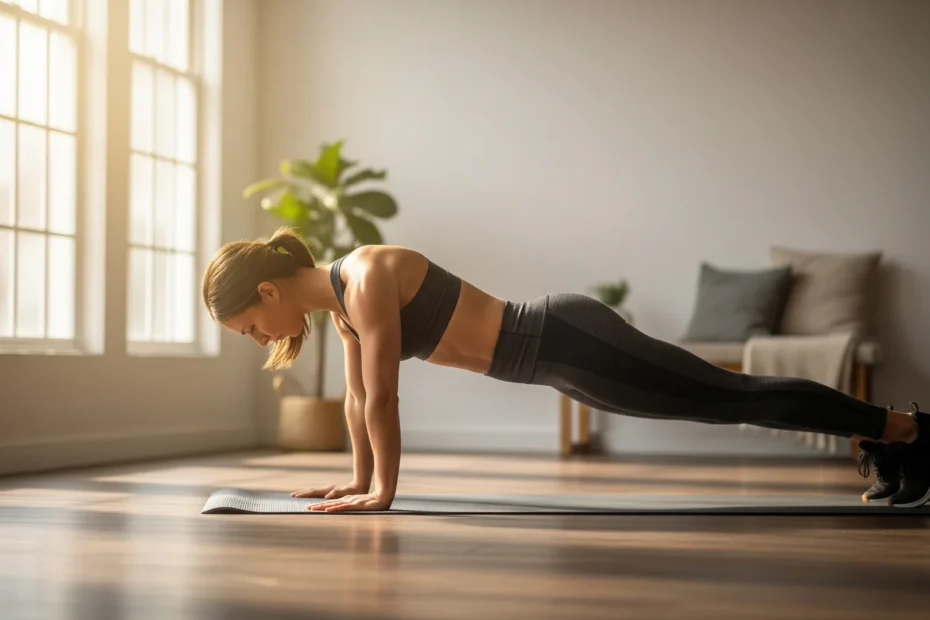
- Plank, hold a straight line from head to heels. Start with 15 to 20 seconds and build from there.
- Step-ups, using a low step or sturdy stair, alternate legs. Aim for 10 reps per side.
This combination works your legs, chest, core and glutes without a single piece of equipment.
Getting Form Right: Common Mistakes Beginners Make
Form matters more than reps when you’re starting out. Ten squats with poor technique build bad habits faster than they build strength. Five squats with excellent technique teach your body the right movement pattern from day one.
The most common beginner mistakes are knees collapsing inward during squats, hips sagging in a plank, and rushing through push-ups without full range of motion. These issues are easy to miss when you’re watching your own reflection, or worse, not watching at all.
Self-teaching from online videos has real limits. A video can show you what the movement should look like. It can’t tell you what your specific movement looks like, or catch the small compensation your body has learned to make. A qualified personal trainer can spot subtle form breakdowns, like a knee caving in during a squat or a lower back arching in a plank, that are almost impossible to self-correct from a video alone.
If you’re unsure whether your form is right, film yourself from the side and compare it to a trusted demonstration. That’s a reasonable starting point. It’s not a substitute for a second pair of trained eyes.
Progressive Overload at Home: How to Keep Improving
Bodyweight training can build real strength, but only if you keep challenging your muscles. This is where progressive overload comes in. It’s the principle of gradually increasing demand on your body so it keeps adapting.
Without any dumbbells or bands, you can still apply this principle. The trick is adjusting other variables instead of adding weight.
Simple Ways to Increase Difficulty Without Weights
- Slow the tempo, take three to four seconds to lower into a squat or push-up instead of dropping quickly.
- Add reps, once a set feels easy, add two to three more reps before you move to a harder variation.
- Shorten rest periods, cutting rest from 90 seconds to 60 seconds increases the challenge without changing a single exercise.
- Try single-limb variations, single-leg glute bridges or split squats demand more balance and strength than their two-legged versions.
Many clients who start with a simple bodyweight routine at home go on to add resistance bands or light dumbbells within a few weeks, once basic movement patterns feel solid. That’s a natural progression, not a requirement from day one.
Staying Consistent With Your Home Fitness Plan
How many days a week should a beginner train? Three sessions a week, on non-consecutive days, is a sensible starting point. This gives your muscles time to recover while building a routine your body can adapt to.
This also lines up with broader public health guidance. Health guidelines for Australian adults recommend at least 150 minutes of moderate activity or 75 minutes of vigorous activity each week, plus muscle-strengthening activities on two or more days.
A few habits make a no-equipment routine easier to stick with long term:
- Schedule it like an appointment. Put your sessions in your calendar, not just your to-do list.
- Stack it onto an existing habit. Train straight after your morning coffee or right before dinner prep.
- Track your progress. Note your reps, sets and how sessions feel each week. Small improvements add up.
- Expect flat weeks. Progress isn’t linear. Missing a session doesn’t mean starting over.
For mums juggling school runs and work, personal training designed for busy mums can offer more structure without adding more to an already full schedule. For those over 50, getting started safely as an older adult is worth a look before ramping up intensity.
When to Upgrade From a Home Workout Routine to a Personal Trainer
A no-equipment routine is an excellent starting point, but it has a ceiling. At some stage, bodyweight exercises alone stop delivering new results. That’s exactly when professional coaching starts to add real value.
Is bodyweight training enough for women wanting to build strength and tone? For the first several weeks, yes. Squats, push-ups, and glute bridges build genuine strength and improve muscle tone. But like anyone else, women who want to keep progressing will eventually need more resistance, more variety, or more precise coaching than a solo routine can offer.
Signs You’re Ready for Coached Sessions
Consider bringing in a trainer if:
- Your basic bodyweight circuit feels easy and you’re not sure how to safely progress it
- You’ve hit a plateau and stopped seeing improvements
- You’ve had a niggle or discomfort during an exercise and want it checked properly
- You want a structured plan tailored to a specific goal, rather than a general routine
- You’d simply train harder and more consistently with someone keeping you accountable
This is where mobile and online personal training fits naturally. Understanding how in-home personal training works shows how a trainer can build on the bodyweight foundation you’ve already set, right in your own living room. If you’d rather start remotely, you can try an online personal training session and get expert guidance without leaving home.
Not every trainer is the right fit for every client, so it’s worth understanding how to choose the right personal trainer before you commit. And if convenience is what drew you to home workouts in the first place, the benefits of mobile personal training extend that same convenience with the guidance of a qualified coach.
Starting exercise at home in Australia doesn’t have to be complicated, and it doesn’t have to be permanent. It’s a genuine, effective first step. When you’re ready for more structure, more progression, or simply more accountability, a free consultation with a Fitness Inside Out mobile or online personal trainer is a straightforward way to build on the work you’ve already started.