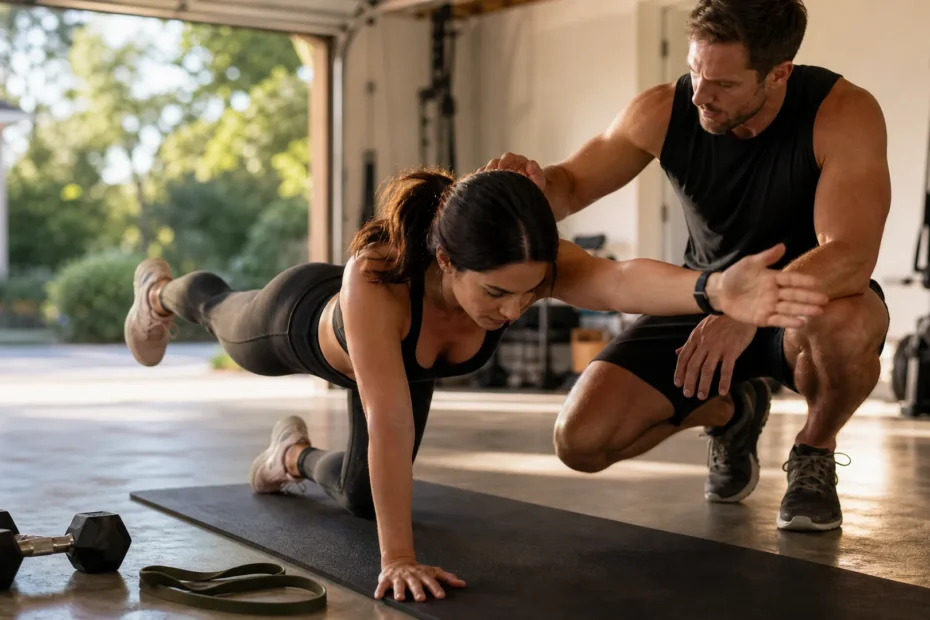
If you’ve ever skipped a workout because the gym felt too far away or too crowded, a personal trainer that comes to your home solves that problem at the source. Instead of building your day around a gym timetable, a qualified trainer arrives at your door, sets up in your living room, garage or backyard, and runs a full session built around your goals. It’s a straightforward, professional service that’s been growing across Australia for years, and it works just as well for weight loss and strength as any gym floor does.
What Is a Personal Trainer That Comes to Your Home?
An in-home personal trainer is a qualified fitness professional who travels to you, rather than asking you to travel to a gym. You get the same programming, coaching and accountability you’d expect from a studio session, just delivered in your driveway, backyard or lounge room instead.
This isn’t a watered-down alternative. Fitness Inside Out has been running mobile, come-to-you personal training since 2001, coordinating trainers across Sydney, the Central Coast, Wollongong, Melbourne and Brisbane. That track record matters. In-home training isn’t a pandemic-era trend. It’s a mature, established way of delivering fitness coaching.
How in-home PT differs from a traditional gym PT
The coaching itself isn’t that different. A good trainer still assesses your movement, sets goals, tracks progress and adjusts your program over time. What changes is the environment and the logistics.
With gym-based PT, you drive to the gym, find parking, wait for equipment and train in a space full of strangers. With an in-home personal trainer, the session starts the moment they walk through your door. There’s no commute, no membership fees stacked on top of session costs, and no waiting for equipment. For many people, that removes the exact friction that was stopping them from training consistently in the first place.
What Happens in a Home Visit Personal Trainer Session in Australia
A home visit personal trainer session in Australia follows a similar structure to a gym session, just adapted to your space. Knowing what to expect makes that first booking far less intimidating.
Before the first session: goals and space assessment
Trainers typically assess your goals, available space and any equipment on hand during the first visit, then build a program around what’s realistically achievable in your home long-term. This might mean a quick walk-through of your living room, backyard or garage to work out what’s usable, and a conversation about injuries, current fitness level and what you actually want to achieve.
This upfront planning is what makes at-home training genuinely effective rather than improvised. Your trainer isn’t guessing what will work in your space. They’re designing around it.
During the session: warm-up, main workout, cool-down
Most sessions follow a familiar rhythm: a short warm-up to raise your heart rate and prep your joints, a main workout block built around strength, cardio or a mix of both, and a cool-down with stretching to finish. Session length is generally similar to a standard gym PT session, and the trainer brings any equipment needed to fill the gaps in your home setup.
Because the session is one-on-one and happening in your own space, there’s also more room for real conversation about form, pacing and how your body is responding, without the noise and distraction of a busy gym floor.
Equipment Needed for At-Home PT Sessions
One of the biggest hesitations people have about at-home PT sessions is assuming they need to build a home gym first. That’s not the case.
What your trainer brings vs what you need
A typical in-home session might use nothing more than a set of resistance bands, a kettlebell and your own hallway or backyard. You don’t need a gym floor to get results. Trainers generally bring portable equipment like bands, mats, light dumbbells and kettlebells with them, so you don’t need to invest in anything before your first session.
What you need is space to move. A lounge room, garage, deck or patch of backyard is usually enough. Your trainer works with what’s available and builds the program around it, rather than expecting you to have squat racks or cardio machines at home. This is exactly why in-home training suits a personal trainer without a gym setup so well: the workout adapts to your house, not the other way around.
Booking Process: Getting Started With Personal Trainer Home Sessions
Getting started with personal trainer home sessions is meant to be simple. The process is designed to remove barriers, not add them.
How to book your first mobile personal training session
Booking usually starts with a quick enquiry, either online or by phone, where you share your goals, your general location and any injuries or limitations. From there, a trainer is matched to your area and a first session is scheduled at a time that suits you: early morning, lunchtime or evening.
That first session doubles as your goals and space assessment, so there’s no separate consultation needed before you actually start training. If you’re in one of the serviced regions, you can look into in-home coaching in Sydney, a mobile personal trainer on the Central Coast, or home visit personal training in Wollongong to see what’s available near you. When you’re ready, you can book your first at-home session and get a trainer matched to your goals and location.
Session Formats: 1-on-1, Group and Online Personal Training Options
Not everyone wants the same format, and mobile personal training how it works can flex depending on your budget, schedule and whether you’d rather train solo or with someone else.
Options typically include:
- 1-on-1 sessions, fully individual coaching and programming.
- 2-on-1 or small group sessions, where you train with a partner, housemate or family member and split the cost.
- Online sessions, coached remotely via video, useful when travel isn’t practical or you’re combining in-person and virtual training.
Choosing between in-person and online sessions
In-person sessions make sense when you want hands-on coaching, real-time form correction and someone physically present to keep you accountable. Online sessions work well as a flexible add-on, for travel weeks, or for people who want structured coaching without a trainer needing to be on-site every time. If you’re weighing up the two, it’s worth reading online personal training explained to see how the virtual format actually runs session to session. Many clients mix both, using in-person sessions for the bulk of their training and online check-ins to stay on track between visits.
Getting Real Results Without a Gym
The question people ask most is whether training at home can actually deliver results. It can. Strength, fat loss and fitness improvements come from consistent, well-programmed training and progressive overload, not from the specific building you train in. A trainer who understands programming can get you the same outcomes in your garage as they could in a fully equipped gym.
Who benefits most from at-home PT (busy professionals, over 50s, teens, NDIS participants)
Several groups get particular value from this format:
- Busy professionals who can’t reliably fit gym visits around work and family commitments.
- Over 50s who want training designed for over 50s that’s tailored to joint health, balance and long-term strength.
- Teens building confidence and fitness habits without the intimidation of a busy gym environment.
- NDIS participants, for whom NDIS personal trainers who visit your home remove transport as a barrier to consistent movement.
Clients recovering from injury or managing a chronic condition often start with mobile exercise physiology sessions at home before progressing to standard in-home PT. That gives them a safe, supervised way to rebuild capacity before ramping up intensity.
Many people who lapse on traditional gym memberships cite lack of time and travel as the main barrier. That’s the core reason mobile, at-home training has grown in popularity over the past decade. If that sounds like you, a personal trainer that comes to your home removes the exact obstacle that’s been getting in your way. The best next step is simple: book a first session, let a trainer assess your space and goals, and find out firsthand how much you can achieve without ever setting foot in a gym.