
Choosing between small group personal training and 1-on-1 coaching isn’t about which format wins in a vacuum. It’s about which one fits your budget, your motivation style, and your actual goals. Both deliver professional programming and accountability without a gym membership, but they serve different needs for busy Australians juggling work, family, and health.
Understanding the practical differences helps you commit to a routine that sticks, instead of cycling through memberships you quietly abandon. Here’s how the real trade-offs in cost, attention, and convenience stack up, so you can pick the training format that fits your life right now.
Defining Small Group vs 1-on-1 Personal Training Formats
The difference between these formats isn’t just headcount. It changes how your trainer gives feedback and how hard you get pushed. Knowing what you’re signing up for stops mismatched expectations before you’ve even started your first session, online or in person.
What counts as small group training?
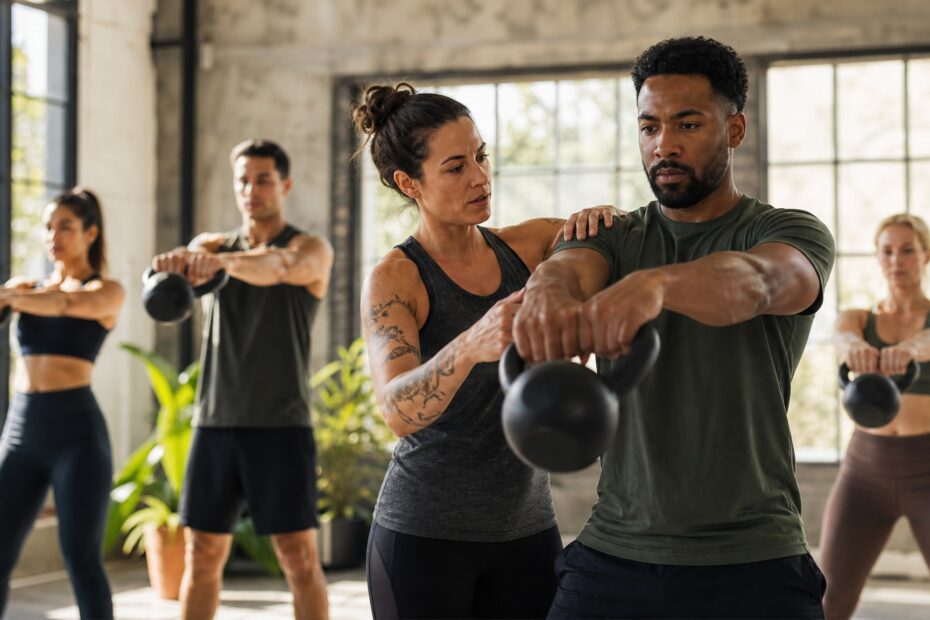
Small group personal training usually means more than three but fewer than ten people, training under direct supervision with shared equipment and coordinated programming. That’s a different experience from a big commercial fitness class, where the instructor demonstrates from the front and can’t correct your form or adjust your load in real time.
You get coaching cues tailored to the group’s ability level, plus the energy of training alongside other people. Trainers manage this by setting up stations or circuits, so everyone keeps moving without long waits between sets.
How 1-on-1 sessions differ in structure
Private sessions put every minute of contact time on your movement, your pacing, your progress. Nothing is divided. Your trainer watches for small compensations during a lift and adjusts your volume on the spot, based on how you’re actually moving that day rather than a template written for a group.
That kind of focus makes 1-on-1 training especially good for learning a complex skill or managing a nagging injury that needs constant monitoring. You also control the schedule and the exercise selection entirely, since no one else’s preferences shape the session.
Cost Comparison: Value Per Session in Australia
Budget often decides consistency more than willpower does. That makes the price structure of your chosen format a real factor in whether you stick with it. According to ACE Fitness, small group workouts can cost around $20 per person, compared to $65 for a standard one-hour individual session. For anyone training multiple times a week, that gap adds up fast (ACE Fitness).
Price differences between formats
The economics favour groups. A trainer running a small group session with six participants brings in around $120 an hour, versus $65 from a single client, and that gap is what lets them pass savings on to you. You still get professional coaching, just at a lower cost per visit, in exchange for sharing the trainer’s attention.
Individual sessions cost more because you’re buying exclusive access to a qualified professional’s time for the full hour. For more on how experience, location, and specialisation move these numbers, personal trainer cost factors in Australia explains why quotes vary so much between providers.
Why cost-sharing makes consistency easier
A lower price per session removes the guilt that makes people skip workouts when money’s tight. When training stays affordable through a lean month, you protect the habit instead of treating fitness as the first thing to cut.
Splitting the cost with training partners also creates a kind of social contract. You show up partly because the others expect you there, and that turns an optional expense into a commitment that survives a bad week.
Accountability and Motivation: Which Format Keeps You Consistent?
Accountability looks different depending on whether you run on external validation or internal discipline, and neither is better for results. What matters is matching the format to your personality, so showing up feels supported instead of forced.
Social accountability in small groups
Training alongside other people creates pressure that helps you push through fatigue when your own motivation runs out mid-session. Seeing the same faces week after week builds the kind of camaraderie that turns a workout into a fixed point in your calendar, not a chore.
This works especially well if you struggle to hold yourself accountable alone. That said, social pressure isn’t a substitute for technical oversight: the trainer still has to make sure group energy doesn’t come at the cost of safe form.
Personalised check-ins during 1-on-1 sessions
Private coaching gives you a trainer tracking the small stuff: how you’re progressing, and what in your life, bad sleep, a brutal work week, needs factoring into today’s session. They’ll notice tension in your warm-up that traces back to yesterday’s desk posture and adjust the plan before it turns into an injury.
You can also be honest about barriers you might not raise in front of a group who have their own stuff going on. That level of attention suits anyone who needs emotional safety alongside physical coaching to stay in it long-term.
Progress Pace and Individualisation for Specific Goals
Neither format is faster by default. What matters is whether your goal matches the kind of attention you’re getting. Get that wrong and you’re wasting time no matter what you’re paying per session.
When 1-on-1 accelerates results
Full attention speeds up technique mastery for complex lifts, Olympic lifts, post-rehab work, anything where millimetres matter. Your trainer can spend the whole session drilling one weakness without worrying about keeping anyone else moving.
Anyone working with mobile exercise physiology to recover from injury often needs this level of detail to rebuild capacity without re-injuring themselves. If your goal needs precise load management or daily adjustments based on symptoms, private sessions cut out the lag you’d get waiting for a group modification.
Adapting small group training for mixed abilities
Good trainers scale exercises within a small group so people at different fitness levels all get the right stimulus, nobody left behind, nobody held back. Regression and progression frameworks let everyone work at their own edge in the same session.
That means you can train alongside friends or colleagues even with a big strength gap between you, without anyone compromising on safety or results. Progress on highly technical goals might be slower this way, but general fitness, body composition, and functional strength all improve reliably when the programming is scaled well.
Convenience of Mobile and At-Home Training Options
Friction kills consistency faster than low motivation ever does, which is why bringing coaching to your own environment changes how often you actually show up. Mobile personal training brings either format directly to your home, workplace, or local park across Sydney, Melbourne, Brisbane, Central Coast, and Wollongong.
Bringing small group training to your space
Hosting small group personal training at home cuts out the commute and the childcare juggling that derails a lot of well-intentioned fitness plans. Your trainer brings the equipment and handles setup and pack-down, so your living room is back to normal the moment the session ends.
A local park works the same way: no facility bookings, no peak-hour crowds, just fresh air. That flexibility means you can schedule around school drop-off or a gap between meetings, instead of rebuilding your day around a gym’s opening hours.
Flexibility of private mobile sessions
One-on-one mobile sessions give you the most scheduling freedom, since you’re only coordinating with your trainer, not a whole group’s calendars. Early morning or late evening slots suddenly work once the travel time disappears from both ends.
If you work from home, you can slot in a thirty-minute session between calls without showering or changing twice. Why gym memberships often fail busy people goes into why cutting transit time out of the equation protects a routine that would otherwise collapse.
The Middle Ground: Benefits of 2-on-1 Personal Training
2-on-1 personal training sessions sit in the middle: near-private attention with shared cost, something neither extreme fully offers. Fitness Inside Out runs 2-on-1 personal training as its own service tier, built for pairs who want personalised programming without paying full solo rates.
It suits couples, friends, or colleagues whose goals line up closely enough to share programming while each still getting individual form correction. You split the hourly rate roughly in half and keep most of the customisation and feedback you’d get one-on-one.
Trainers alternate focus between the two of you during rest periods, so engagement stays high without the dilution you’d get in a bigger group. It also works as a trial run, a way to find out whether you thrive in a group setting before committing to a bigger cohort, or deciding to go back to solo training.
Choosing the Right Personal Training Format for Your Lifestyle
No format wins for everyone, because what you can sustain depends on where you’re at right now. If geography or a rigid schedule is part of your decision, online versus in-person training options is worth weighing up too.
Decision factors for busy Australians
Weigh your budget against how much technical precision you need, and whether you respond better to social or solitary motivation. An honest read on this saves you from paying for premium attention you don’t use, or putting up with group pacing that frustrates your progress.
It’s also worth asking whether you’ve got the bandwidth right now to coordinate other people’s schedules, or whether simplicity matters more this season. Parents working around school holidays, or anyone mid project-crunch, often find the right format shifts throughout the year rather than staying fixed.
Matching format to your current fitness stage
If you’re recovering from injury or still learning the basics, private sessions early on build the confidence to move safely. Once that competence is there, shifting to small groups keeps the momentum going at a lower cost, with the social element keeping boredom at bay.
Advanced athletes chasing specific performance numbers might cycle back to 1-on-1 periodically for technical work, then return to a group for maintenance. The best format, in the end, is the one you’ll actually turn up to, whether that’s private focus or shared energy, so weigh real-world adherence over what sounds best on paper.
If you’re still not sure which path fits, get in touch to discuss your training options with our team and we’ll map out a plan around your goals and constraints.
Frequently Asked Questions
How much does 1-on-1 personal training usually cost in Australia?
Standard one-hour individual sessions typically cost around $65, though rates vary based on trainer experience, location, and specialisation. Premium coaches in major cities or those with clinical qualifications may charge significantly more, while newer trainers sometimes offer introductory packages below market average.
What does ‘1-to-1 training’ actually mean?
It refers to private coaching where one trainer works exclusively with one client for the entire session duration. Every aspect of programming, feedback, and pacing is customised solely to that individual’s goals, injuries, and daily readiness without sharing attention or equipment with others.
Can you get fit just doing group classes instead of personal training?
Group classes improve general fitness and cardiovascular health effectively for many people, but they lack individualised progression and form correction. Without personalised adjustments, plateaus occur faster and injury risk increases for those with pre-existing conditions or complex movement histories.
Is 2-on-1 personal training worth it compared to solo sessions?
Yes, if you have a compatible training partner and want to reduce costs while retaining most benefits of private coaching. You sacrifice some exclusivity but gain accountability and affordability that often improves long-term consistency, which matters more than marginal attention differences for general fitness goals.