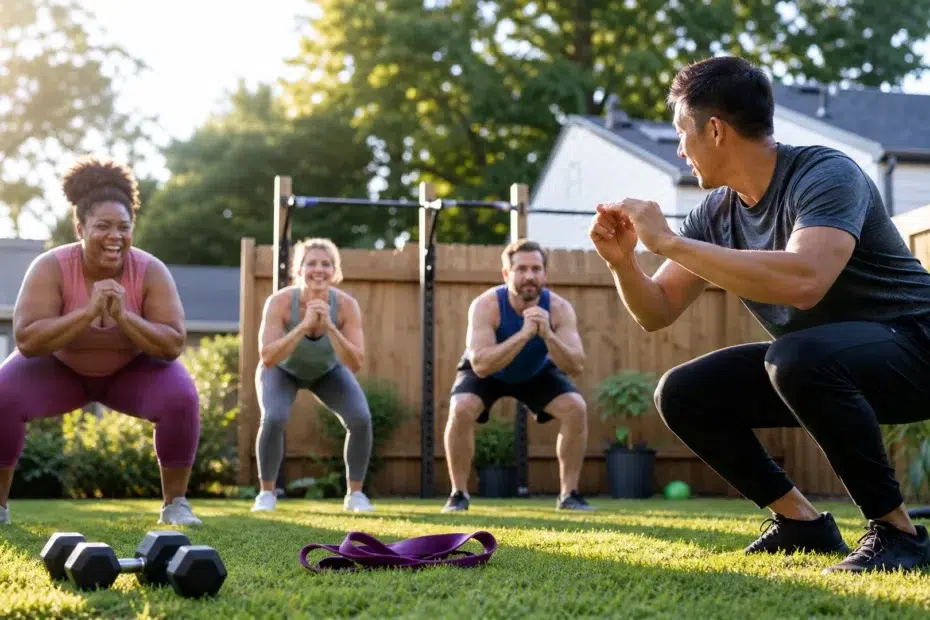
Grabbing a few mates, your partner, or the neighbours and training together in someone’s backyard is one of the most underrated ways to get fit in Australia. Small group personal training at home brings a qualified coach to your space. It splits the cost across the group and keeps everyone accountable to each other. It’s a middle ground between solo PT and a crowded gym class, and it’s easier to organise than most people think.
What Is Small Group Personal Training at Home?
Small group personal training at home means a qualified trainer comes to a house, backyard, or shared outdoor space and runs a session for a group instead of one client. Groups usually sit between three and six people. That’s small enough for the trainer to still watch technique and coach each person properly. It’s also large enough to bring the energy and banter of a group workout.
There’s no gym membership, no studio booking, and no travel. The trainer brings the equipment, sets up in your space, and runs the same kind of structured program you’d get in a studio.
How Small Group PT Sessions at Home Differ From 1-on-1 or 2-on-1 Training
Small group sessions are the natural next step up from smaller formats. If you’ve looked at stepping up from 2-on-1 personal training, small group PT works on the same principle, just with more people sharing the trainer’s time and the cost.
With 1-on-1 training, every minute of coaching is focused on you. With a small group, the trainer manages the room, cycles between people, and builds a session that works for everyone at once. You get less individual attention than solo PT, but far more than you’d get in a gym class of twenty people. For many, that trade-off is worth it for the price and the company.
The Real Cost of Group Fitness Without a Gym
One of the biggest drivers behind small group PT sessions is cost. When one trainer works with several people at once, the cost of that trainer’s time gets shared across the group. Each person pays less than they would for a solo session, and the trainer still earns a fair rate for their time.
Compare that to a gym membership. You pay an ongoing fee for access to equipment and space, but you don’t get any coaching unless you pay extra for it separately. With small group training at home, coaching is built into every session. There’s no membership fee sitting in the background, and no guesswork about whether you’re doing an exercise properly.
Cost-Per-Head: Why Splitting a Session Beats Solo PT or Gym Membership
Think of it as cost-per-head rather than a flat session price. A group of four or five people splitting one trainer’s time will each pay noticeably less than they would booking that same trainer solo. Yet everyone still gets a program built around their goals, proper coaching cues, and someone watching their form.
That’s the appeal for households, friend groups, and workmates who want quality coaching without the price tag of individual sessions. It also beats paying for a gym membership you might only use sporadically. Every dollar you spend on group PT goes toward an actual coached session, not idle access to equipment.
How Group Personal Training Groups at Home Are Structured
A well-run small group session at home follows a similar shape to any good PT session, just adapted for more bodies and less predictable space.
A Typical Session Format
Most sessions start with a warm-up to get the group moving and prepare joints and muscles for the work ahead. From there, the trainer moves into the main block. This is usually a mix of strength and conditioning work using equipment like resistance bands, kettlebells, or bodyweight circuits. The session wraps with a cooldown and some stretching, giving everyone a chance to catch their breath and chat before heading back inside.
Because there’s no gym on hand, the trainer brings whatever equipment the session needs. That might mean a car boot full of gear, or a compact kit designed for backyard and living room training. Either way, you don’t need to own anything or set up a home gym yourself.
Programming for Mixed Fitness Levels
One of the most common questions about small group PT is whether it works when people are at different fitness levels. It does, as long as the trainer knows how to scale a session properly.
A trainer running the same circuit for a mixed group might have one person doing lower-impact step-ups while another does jump squats, using the same basic movement pattern at two different intensities. That way, everyone works from the same program, but at a level that suits their fitness, injury history, or experience. It’s one of the biggest advantages of a coached group over just following an app or a video together.
Who Small Group PT Sessions in Australia Suit Best
Small group training tends to suit people who already have some kind of social connection and want to turn it into a fitness habit.
Friends, Neighbours, Families and Workmates
Neighbours who already walk together, or a family that trains in the backyard on weekends, are typical examples of small groups. They already have the social habit. Small group PT just adds structure, coaching, and progression to it.
This format works well for busy parents who want to train without adding another solo commitment to their week. For group training options for busy mums, it can be easier to commit to a session when a friend is doing it alongside you. It also suits group sessions designed for older adults who want company and safety in numbers, teens training with siblings or friends, and workmates who want to train before or after work without heading to a gym.
People in group exercise settings tend to stick with it longer than solo trainers do, largely because they feel accountable to each other, not just to the trainer. Turning up matters more when you know someone else is waiting for you.
When 1-on-1 or Online Training Might Suit You Better
Small group PT isn’t the right fit for everyone. If you’re working through an injury, need rehab-focused programming, or want a session built entirely around your own goals, 1-on-1 training gives you that individual attention. If your schedule is unpredictable or you travel a lot, online training might suit you better than committing to a fixed group time. Small group PT works best when a few people can commit to the same time slot regularly.
Home and Outdoor Settings for Group Fitness Sessions
Part of what makes this model work is that it doesn’t need a gym, a studio, or even much space. Mobile trainers are used to working with whatever’s available.
Backyard, Living Room or Local Park: Choosing Your Space
A backyard with a bit of open grass is often the easiest option, especially in warmer months. Garages and living rooms work well too, particularly for strength-based circuits that don’t need much room to move. If nobody’s home has the space, a local park is a solid alternative. Trainers experienced in running sessions in local parks know how to set up a full session with minimal equipment.
Whichever space you choose, the point is the same: you’re not restricted to a gym floor. This is part of the broader case for staying fit without a gym membership while still getting proper coaching. It also connects to the broader benefits of mobile personal training, where convenience is the whole point of the model.
Getting Started With Home Group Training Sessions
Once you’ve got a few people keen to train together, organising a small group PT session is straightforward.
What to Ask Before You Book
Before you lock in a session, it helps to agree on a few basics as a group. How many people are actually keen to commit to a regular time? What space will you use, and is it available consistently? Are your goals roughly aligned, whether that’s general fitness, strength, or weight loss? And how often do you want to train each week? Sorting these out upfront means the trainer can build a program that suits the whole group from session one. If you’re still weighing up formats, it’s worth reading about how to choose the right personal trainer before you commit.
How Fitness Inside Out Sets Up Your Group
Fitness Inside Out has offered 1-on-1, 2-on-1 and small group mobile personal training since founders Jacqueline Zonneveld and Jude Tarran started the business in 2001. That history means the team has spent two decades matching trainers to different group dynamics, from families to workmates to long-time neighbours.
Fitness Inside Out trainers travel to backyards, living rooms and local parks across Sydney, Central Coast, Wollongong, Melbourne and Brisbane to run small group sessions. The group never has to find or book a venue. You tell the team your group size, goals, and preferred location, and they match you with a trainer who suits your fitness levels and schedule.
If you’ve got a few people ready to train together, get in touch to set up your group session and get matched with a mobile trainer near you.