
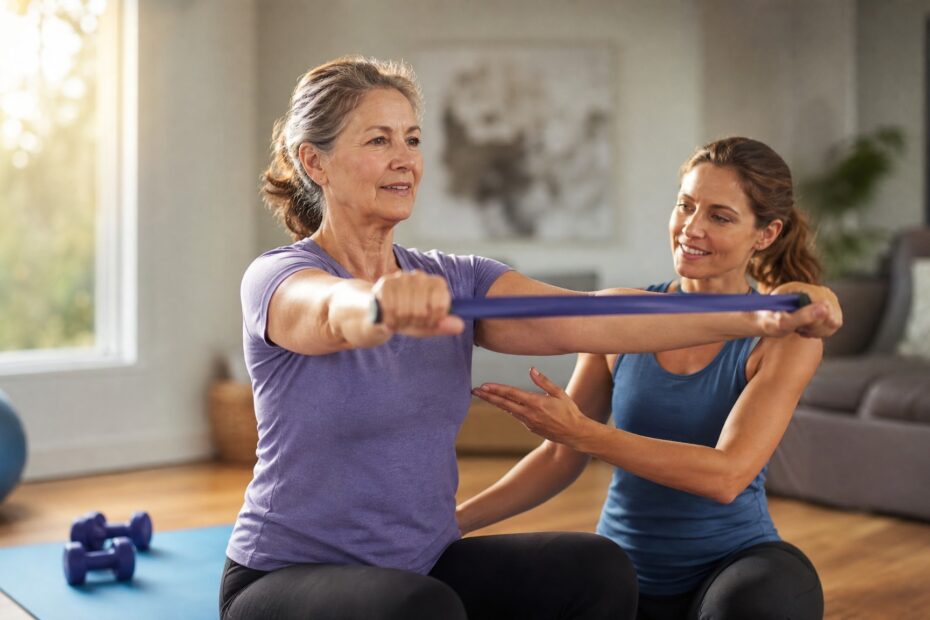
Turning fifty often brings a stark realisation: the fitness strategies that worked in your thirties no longer suit your body or your schedule. Joints that used to be resilient feel stiff. Weight settles differently despite unchanged eating habits. Maybe you just don’t feel confident walking back onto a gym floor after years away. A personal trainer for over 50s at home removes these barriers by bringing professional guidance straight to your living room, backyard, or local park. This approach respects where your body is right now while building the strength and mobility you need for the decades ahead.
Fitness Inside Out has provided mobile and online personal training adapted for ageing Australians since 2001, servicing clients across Sydney, Central Coast, Wollongong, Melbourne, and Brisbane. Staying active in your 50s takes more than just showing up. It needs programming that balances effort with recovery. Whether you’re managing a chronic condition or just want to keep pace with your grandchildren, expert coaching takes out the guesswork and keeps you moving safely.
Why Fitness in Your 50s Requires a Different Approach
Your fifties are a distinct physiological decade. Hormonal shifts and metabolic changes mean generic senior fitness advice often misses the mark. Sarcopenia, the gradual loss of muscle mass, typically accelerates after age 50, which makes targeted strength work essential for preserving your metabolic rate and physical capability, not just how you look. A program built around low-impact cardio alone won’t cut it. Effective fitness for over 50s in Australia has to address muscle preservation and bone density to head off long-term decline.
This isn’t about training like a twenty-year-old, and it isn’t about being treated as frail.
Navigating Hormonal and Metabolic Shifts
Hormonal changes during this decade change how your body stores fat and builds muscle. Standard calorie-burning workouts often deliver diminishing returns as a result. Resistance training becomes the main lever for metabolic health, because maintaining lean mass helps regulate insulin sensitivity and how many calories you burn at rest. You need a program built around these biological realities, not one that fights them with excessive volume or intensity that leads to burnout. A knowledgeable trainer adjusts your workload to match your hormonal baseline, so you keep progressing without overwhelming your system.
Prioritising Joint Health and Mobility
Training has to respect the condition of your joints today while building resilience against future wear. Mobile trainers adapt exercises in real time based on how you’re feeling that day, so a stiff shoulder or a flare-up doesn’t derail the session. That means clients can train consistently without aggravating chronic conditions like osteoarthritis, something a pre-recorded video or a crowded gym class simply can’t offer. By focusing on controlled range of motion and proper alignment, your trainer protects vulnerable areas like knees, hips, and shoulders while still giving you the stimulus you need for strength gains.
Benefits of an In-Home Trainer for Over 50 Clients
Choosing an in-home trainer for over 50 clients gets you more than saved travel time. The privacy of your own space removes the performance anxiety a lot of people feel in commercial gyms, so you can focus on movement quality instead of who’s watching. Cut out the commute and the unfamiliar equipment, and showing up gets a lot easier. That’s why adherence improves. You’re far more likely to finish a session when the only requirement is stepping into your lounge room at the agreed time.
Safety Through Supervised Form Correction
Safety concerns keep a lot of people away from weights, yet supervised form correction is exactly what makes resistance training safe at this stage of life. Your trainer watches every rep to make sure your spine stays neutral and your joints track correctly, and steps in the moment fatigue starts to compromise your technique. This feedback loop stops bad habits from setting in and protects you from injuries that could set your progress back by months. For anyone with existing niggles or postural issues, that level of oversight turns exercise from a risk into a genuinely therapeutic tool.
Convenience That Supports Consistency
Consistency matters more than intensity when you’re rebuilding fitness in mid-life. The benefits of mobile personal training include having a professional handle your equipment setup and warm-up, so you move straight into productive work. It fits around school drop-offs, work meetings, and caring responsibilities without asking you to carve out extra hours for transit. When life gets chaotic, a trainer arriving at your door becomes a non-negotiable appointment that anchors your week.
Strength Training Over 50: Building Functional Power
Exercise physiologists widely recognise resistance training as the main way to fight age-related muscle loss and keep you functionally independent through your fifties. Strength training over 50 should centre on compound movements that mirror real-world demands, not isolate single muscles on machines. You build power that translates directly to daily tasks, from carrying groceries to standing up from a low chair without using your hands. That functional focus keeps motivation high, because every gain has a use outside the workout.
Resistance Work for Bone Density and Muscle Mass
Loading your skeleton through weight-bearing exercise stimulates bone remodelling, which matters for offsetting the natural decline in density that happens during this decade. Progressive resistance also fights sarcopenia by giving your muscles the mechanical tension they need to retain and build type II fibres. Walking alone won’t get you there. It takes deliberate loading that challenges your musculoskeletal system within safe limits, and your trainer prescribes loads and volumes calibrated to trigger those protective adaptations without leaving you overly sore or fatigued.
Functional Movements for Daily Independence
Squats, hinges, pushes, and pulls form the foundation of a program built to preserve your independence. Master these patterns and you keep the capacity to handle uneven terrain, lift objects safely, and recover from a stumble. You train movements, not just muscles, which builds the coordination and reaction time that back up real-world strength. That practical strength is what gives you the confidence to throw yourself into hobbies, travel, and family activities without worrying about physical limits.
Returning to Exercise After a Long Break
Restarting fitness after years of being sedentary takes patience and a structured plan that meets you at your current starting point. A lot of people in their fifties carry memories of past athletic ability that clash with present reality, and when ego drives the pace, that’s where frustration or injury creeps in. A phased return-to-exercise strategy builds confidence through small, measurable wins before intensity or complexity increases. You relearn how to read your body’s signals, telling productive discomfort apart from warning pain.
Assessing Baseline Fitness Safely
A thorough initial assessment identifies limitations, asymmetries, and safe starting loads before any strenuous work begins. It looks beyond simple strength tests to check mobility, balance, and how your cardiovascular system responds to mild exertion. Your trainer uses that data to design a program that meets you exactly where you are today, not where you were twenty years ago. An accurate baseline heads off the most common mistake among returning exercisers: doing too much, too soon.
Progressive Overload Without Injury
Increasing difficulty has to follow a predictable path, one that lets connective tissue adapt alongside muscle. Tendons and ligaments strengthen more slowly than muscle bellies, so your trainer manages volume and frequency carefully over the first twelve weeks to avoid overuse injuries. You might add reps before you add weight, or improve tempo control before a new exercise gets introduced. That methodical progression is what makes the adaptation stick, and it proves to your nervous system that more effort is safe.
Choosing Between Mobile and Online Personal Training
Deciding between face-to-face and virtual coaching comes down to how you learn, what keeps you accountable, and how flexible your schedule is. Live online sessions work well for older adults who need form correction and accountability but can’t always fit in a face-to-face visit. High-definition video lets trainers spot alignment issues and cue corrections in real time, bridging the gap between exercising alone and having someone hands-on. That said, some clients get more out of the tactile cues and equipment handling that only an in-person session provides.
You can weigh up the two by reading our comparison of online versus in-home training options to see which suits your lifestyle right now. If you’re coming from strength training at home for women over 40, online coaching might be all you need, while anyone managing complex injuries usually prefers the direct oversight of mobile visits. The right choice is whichever format you’ll actually use, week after week.
What to Expect from Fitness Inside Out Sessions
Our mobile service takes the logistics off your plate by bringing everything a complete session needs straight to you. Trainers arrive with portable resistance bands, dumbbells, kettlebells, and mats, and turn any clear floor space into a fully equipped studio. You don’t need to buy equipment or find somewhere to store it. We handle the setup and pack-down, so you focus solely on the work.
Tailored Programming for Australian Lifestyles
Programs account for the realities of Australian living: outdoor heat, unpredictable work schedules, multi-generational households. Your trainer designs sessions around your specific context, whether that’s an early morning park session before the summer heat rises or an evening workout after the kids are asleep. We’ve refined this adaptive approach over two decades of working with communities from Brisbane to Melbourne. If your circumstances change and you eventually need training for seniors over 60, your programming evolves with you.
Bringing Professional Equipment to Your Doorstep
The equipment your mobile personal trainer brings to a home session for over 50s clients is chosen specifically for safety and versatility. Adjustable dumbbells allow precise load matching, while resistance bands give you joint-friendly tension that free weights can’t replicate. Stability aids and balance tools address fall prevention without cluttering up your home permanently. This curated kit covers strength, mobility, and conditioning work inside the footprint of a standard lounge room.
Taking the First Step Towards Sustainable Activity
Professional guidance turns vague intentions into a structured plan, especially once you factor in the specific considerations that come with training in your fifties. You deserve a training partner who understands that staying active in your 50s is about preserving your quality of life, not chasing arbitrary numbers. Our specialised over 50s personal training services give you the expertise and accountability you need to move forward with confidence. Book a free consultation today to talk through your health history, mobility goals, and preferred training location with a qualified mobile trainer.