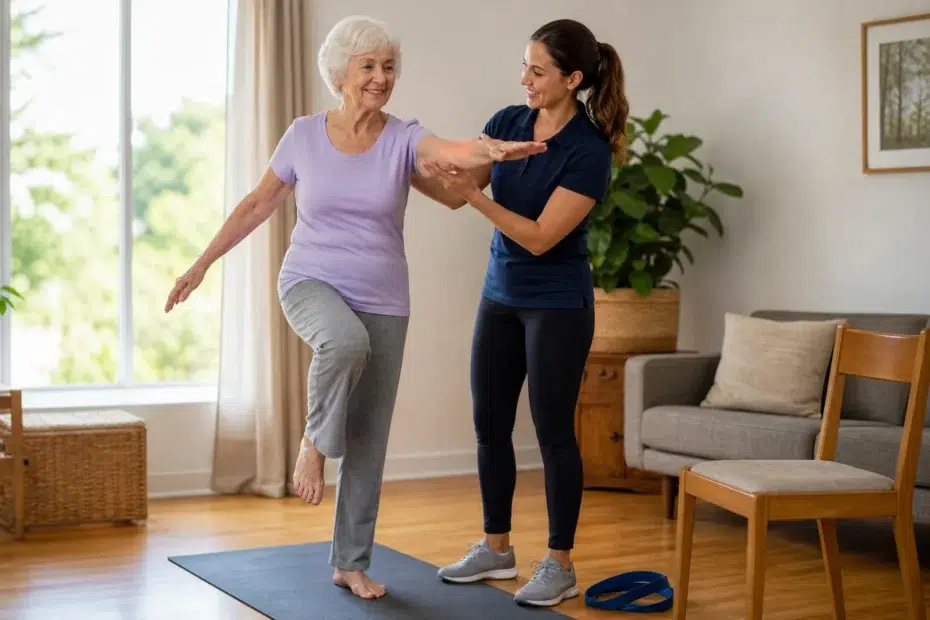
Staying strong and independent in your 60s, 70s and beyond usually comes down to finding a routine that fits your actual life, not one that forces you into a gym that no longer works for you. A personal trainer for seniors over 60 at home cuts out the commute, the crowded gym floor and the intimidating equipment, and replaces all of it with professional coaching in your living room or backyard. This isn’t about chasing personal bests or keeping up with a younger crowd. It’s about keeping the strength, balance and confidence you need to live life on your own terms. Fitness Inside Out brings qualified mobile trainers to clients across Greater Sydney, Central Coast NSW, Illawarra NSW, Greater Melbourne and Brisbane who want expert guidance without leaving their front door.
This service suits older adults who want safe, supervised movement. It isn’t a replacement for acute medical care or rehab immediately after surgery or a hospital stay.
Why In-Home Fitness for Seniors Beats the Gym Environment
You deserve a training space where you can focus on how your body feels, not on navigating unfamiliar machines or feeling out of place in a crowded facility. Take away the physical and psychological barriers of a traditional gym, and adherence improves. That matters because consistency, not intensity, is what builds long-term resilience against age-related decline.
Removing travel barriers and intimidation factors
Driving to a gym, finding parking, and walking through a busy reception area can wear you out before you’ve even started, especially if you’re managing joint pain or fatigue. Training at home removes those logistical hurdles entirely, so you save your energy for the actual workout. It also removes the anxiety many seniors feel in commercial fitness spaces dominated by younger crowds. Your own home becomes a safe space to move, where mistakes are private and progress is measured against your own baseline, not anyone else’s.
Consistency through convenience and comfort
Bad weather, traffic, and scheduling conflicts derail plenty of gym routines. In-home exercise for elderly clients slots into your existing daily rhythm instead. When your trainer arrives at your door, the only thing you have to do is show up in your own space, which cuts out most of the planning and preparation that leads to skipped sessions. That convenience turns exercise from a chore that takes willpower into a reliable appointment, one that supports staying active in your 60s and 70s no matter what else is going on.
Balance Training for Older Adults: Preventing Falls at Home
Falls are the leading cause of injury-related hospitalisation for Australians aged 65 and over. One in three older Australians has a fall each year, according to national data from the Australian Institute of Health and Welfare. Addressing that risk takes targeted balance work in the exact environment where most falls actually happen, not on the predictable, flat surfaces of a gym.
Functional movements that mimic daily life
Balance deteriorates once you stop challenging your body’s ability to adjust to uneven surfaces, sudden direction changes, and dual tasks like carrying groceries while stepping over a doorstep. Your trainer builds in exercises such as tandem walking, single-leg stands near the kitchen bench, and weight-shifting drills that mirror the exact motor skills you need to move safely around your own home. These movements build the neural pathways that carry over to real life, cutting fall risk far more than an isolated machine exercise ever could.
Progressive stability work without heavy equipment
A good fall prevention program doesn’t need expensive machinery or heavy loads that could be risky to practise unsupervised between sessions. Mobile trainers use minimal gear, resistance bands, foam pads, household furniture, to build progressive challenges that match your current ability while keeping a safety margin in place. You get real-time feedback and spotting on every rep, so balance work pushes you just far enough to build adaptation without tipping into injury risk.
Adapting Strength Training for Over 60s with Joint Pain or Past Injuries
Strength training for over 60s has to account for accumulated wear, old injuries, and conditions like osteoarthritis that make a standard barbell or dumbbell program inappropriate, or just painful. Qualified trainers swap high-load movements for band-based or bodyweight alternatives that still stimulate muscle while protecting vulnerable joints. At this stage of life, preserving function matters more than maximising force.
Low-impact resistance techniques for arthritis and osteoporosis
One Fitness Inside Out client, a 72-year-old with knee osteoarthritis, improved her ability to rise from a chair unassisted within eight weeks, using seated-to-standing progressions and resistance band work at home. That’s proof meaningful strength gains are possible without aggravating existing joint pain. Resistance bands give variable tension that matches your own strength curve, so peak stress on connective tissue drops while you still get enough mechanical load to fight sarcopenia and support bone density. It’s a way to build the muscle you need for independence without trading away joint comfort to get there.
Modifying exercises for limited range of motion
Past surgeries, spinal stenosis, or shoulder impingement might restrict what movements are available to you, but those limits shape your program rather than rule out effective training altogether. Your trainer checks your range of motion every session and adjusts exercise selection on the spot, swapping in movements that hit the same muscles through a safer position. Programming is built around your medical history, pain thresholds, and goals, not a generic template based on your age.
What a Typical Gentle Personal Training Session Looks Like
Gentle personal training for seniors means intensity scaled to what you can actually handle, while still giving you enough of a challenge to see results. It isn’t watered-down exercise that goes nowhere. A standard 45 to 60-minute in-home session follows a structured format: mobility warm-ups, a targeted strength or balance block, and a cool-down stretch, all paced to your energy on the day with rest breaks built in as needed. You control the tempo throughout, and your trainer keeps checking in to make sure the workload stays safe and productive.
Sessions typically start with five to ten minutes of joint mobilisation and light cardio to get your body moving, which also gives your trainer a read on how you’re feeling that day. The main block focuses on two or three priorities from your initial assessment, lower body strength for stair climbing, say, or core stability for posture, worked through in circuits or supersets that manage fatigue. Cool-down brings guided stretching and breathing work that helps recovery and reinforces the mind-body connection, so you leave energised rather than wiped out.
Exercise Physiologist vs Personal Trainer for Seniors: Which Do You Need?
Knowing the difference between these two professionals means you get the right level of clinical oversight for your health status and funding eligibility. If you’re managing several chronic conditions, pairing an exercise physiologist with ongoing personal training keeps things clinically safe while you keep building long-term functional independence, each professional covering what the other doesn’t.
When clinical oversight is necessary
Accredited Exercise Physiologists are university-trained allied health professionals who specialise in managing complex chronic disease, post-surgical rehab, and NDIS or Medicare-funded exercise under a formal care plan. If you’ve recently been hospitalised, are recovering from a cardiac event, or need exercise prescription tied to medical outcomes your GP is monitoring, mobile exercise physiology services provide the clinical governance you need to participate safely. Personal trainers can’t legally manage acute medical conditions or bill Medicare directly, which is exactly why an EP matters once your health complexity goes beyond general fitness.
Collaborative care between PTs and allied health
Plenty of seniors do well with a hybrid model: an exercise physiologist sets the clinical parameters and safety guidelines, then a qualified personal trainer takes over ongoing maintenance and progression in the home. It’s a combination that maximises both safety and sustainability, since your trainer can check in more often and keep you motivated between clinical reviews, all within boundaries the EP has already set. Your trainer stays in contact with your EP or GP to keep everyone aligned, giving you continuity of care that neither profession could deliver alone.
Peace of Mind for Families: Qualified, Accountable Trainers at Your Doorstep
Family caregivers often worry about safety and reliability when arranging in-home services for older relatives, and that concern deserves a straight answer rather than vague reassurance. All Fitness Inside Out mobile trainers hold current First Aid and CPR certifications and complete mandatory working-with-vulnerable-people checks before they see senior clients, credentials your family can ask to see before committing to anything. Session reporting includes documented progress notes and outcome tracking, so family members get structured updates without having to sit in on every session.
Vetting goes beyond paperwork, too. Trainers need to show real competency in ageing-specific programming, fall risk assessment, and communication suited to the cognitive or sensory changes common in older age. During the consultation, you can ask for detail on your assigned trainer’s qualifications, experience with similar clients, and emergency response protocols before you commit to anything. A good mobile trainer knows that earning a family’s trust takes consistent proof of competence, punctuality, and respectful engagement with the client and the people who support them.
Getting Started: Assessment and Building a Realistic Routine
Your first session is low-pressure: it’s there to build trust, check your current capability, and shape a plan around your medical clearance and personal priorities. The initial consult includes a functional movement screen, a chat about your goals, and a look at any relevant medical documentation or allied health recommendations, so your program starts from where you actually are, not from assumptions about your age. Most seniors over 60 notice real strength or balance gains with two to three sessions a week to start, though frequency shifts depending on recovery, budget and how it fits your life.
Health fluctuates, and that’s normal, so your program has room built in to pause, modify or scale back sessions when energy dips or symptoms flare, no penalty and no judgment. You stay in control of pacing and progression, and your trainer adapts each visit on real-time feedback rather than sticking rigidly to a plan made weeks ago. If you want to see whether this approach suits you, book a no-obligation in-home consultation to talk through your mobility goals, health considerations and preferred training frequency with a qualified mobile trainer, face-to-face.
For broader context on ageing and fitness beyond the home setting, our complete guide to personal training for older adults covers more on staying active across different environments. If you’re navigating a midlife transition rather than a senior one, our resources on personal training for over 50s or strength training at home for women over 40 cover adjacent ground. And whatever your age, our guide on how to choose a qualified personal trainer gives you a way to judge competency beyond the marketing claims.