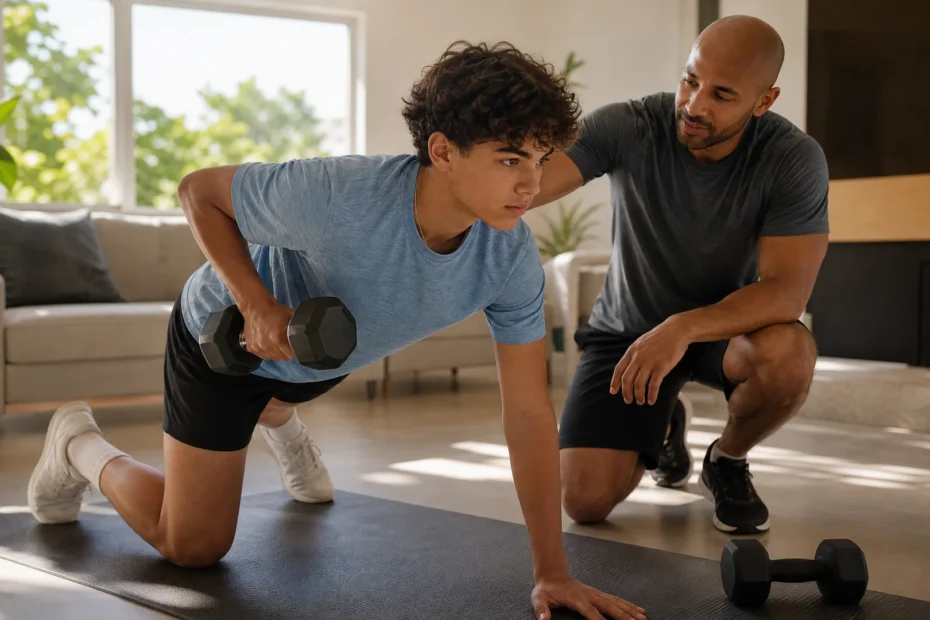
More parents are searching for personal training for teenagers at home, and it’s not hard to see why. Most fitness content out there is built for adults chasing weight loss or kids doing basic active play. Teenagers sit in an awkward middle ground. They’re old enough for structured strength and conditioning, but their bodies, confidence, and motivations look nothing like an adult client’s.
That gap is why in-home and mobile options are gaining traction. Training at home removes the intimidation factor of a busy gym floor. It gives teens privacy while they build skill and confidence. And it fits around school, sport commitments, and family schedules instead of forcing everyone else to adjust.
What Makes Teen Fitness Different From Adult Training
Teenage bodies are still developing. Growth spurts change coordination and flexibility almost overnight. A program built for a fully grown adult can be the wrong fit for a 14-year-old.
Motivation looks different too. Teens often respond better to encouragement, clear technique cues, and small wins than to numbers on a scale. A good teenage fitness program builds skill and confidence first. Strength and performance goals get layered in as the teen matures.
Is a Home Personal Trainer Safe and Appropriate for Teenagers?
Safety is usually the first question parents ask, and it’s the right one. A qualified trainer working with a teenager at home should follow the same duty-of-care standards as any professional working with minors, adjusted for a one-on-one training setting.
Training at home also removes some of the risk factors you’d find in a public gym: unfamiliar equipment, crowded weight areas, teens attempting exercises they’ve copied from social media without proper form. A structured, supervised session in a familiar space is generally a safer starting point.
Supervision and Parental Involvement
Parents don’t need to stand over every rep, but staying involved matters. Most families like to be home during sessions, especially early on. Many trainers welcome a parent checking in at the start and end of a session to discuss goals and progress.
Some parents sit in on the first few sessions to get comfortable with the trainer’s coaching style. Others prefer a quick debrief afterwards. Either approach works. The point is that parents stay in the loop, not that they need to supervise every movement.
Qualifications to Look For in a Teen Personal Trainer Australia
Before booking, check that a teen personal trainer in Australia holds a relevant fitness qualification, current first aid and CPR certification, and a Working With Children Check for the state they’re training in. Ask how much experience they have coaching adolescents specifically. Coaching a 14-year-old is a different skill set to coaching a 40-year-old.
Ask directly how a trainer structures progressions for teens, and how they handle technique correction. If you want a broader checklist for vetting any trainer, it helps to look at how to choose the right personal trainer before narrowing it down to youth-specific credentials.
Age-Appropriate Programming for Youth Fitness Training at Home
Good youth fitness training at home isn’t a scaled-down adult workout. It’s built around where a teenager sits developmentally, not just their age on paper.
Training Considerations by Age Group
Younger teens, roughly 13 to 15, generally benefit most from bodyweight movement, coordination work, and technique coaching. The focus stays on learning to squat, hinge, push, and pull correctly, rather than chasing heavy loads.
Older teens, around 16 to 18, can usually handle more structured strength work once technique is solid. Programming at this stage can start to resemble adult training more closely, with added resistance and more sport-specific elements. Pacing still matters.
Avoiding Overtraining and Injury
Youth strength and conditioning guidance generally recommends mastering movement patterns with bodyweight or light resistance before adding external load, particularly during adolescent growth spurts. Growth plates are still developing through the teenage years. Overloading a joint before technique is solid raises injury risk.
Recovery matters just as much as the workout itself. Teens juggling school, sport, and social life need rest built into their program, not just added exercises. A trainer who paces intensity around a teen’s week, rather than pushing every session to the limit, helps prevent burnout and keeps training sustainable.
Building Confidence Through a Teenage Fitness Program
For a lot of teens, the hardest part of fitness isn’t the exercise. It’s the environment. Gyms can feel exposing, especially for teens who are self-conscious about their bodies or new to structured exercise.
Training at home removes that pressure. There’s no one watching, no comparison to other gym-goers, no pressure to “keep up.” That space lets a teen focus on their own progress instead of worrying about how they look doing it.
Parents often notice better posture, improved school sport performance, and more confidence in social settings once a teen gets comfortable training consistently in a familiar, low-pressure home environment. One-on-one coaching also means a trainer can adjust their communication style to what actually works for that teen. Some need more encouragement, others need clear structure and goals.
For families exploring what’s available beyond one-off sessions, our kids and teen fitness programs are built around exactly this kind of gradual, confidence-first approach.
Sport-Specific Conditioning: PT for Young Athletes Australia
Plenty of parents book a home trainer specifically to support a teen’s school or club sport. This is where PT for young athletes in Australia becomes less about general fitness and more about targeted conditioning.
Sessions can focus on running mechanics, agility and change of direction, and building a strength foundation that supports the specific demands of a teen’s sport. Injury-prevention work, things like ankle stability, landing mechanics, and mobility, often gets folded in too, especially for teens playing high-impact or field-based sports.
Mobile PT for Teenagers Sydney and Beyond
Mobile PT for teenagers in Sydney has become a practical option for families juggling training around school runs, homework, and weekend fixtures. Fitness Inside Out has delivered mobile personal training across Sydney, Central Coast, Wollongong, Melbourne and Brisbane since 2001, giving families a trusted, come-to-you option for teen fitness coaching.
Because the trainer comes to you, there’s no drive to a gym or club after an already long day. Sessions can happen in the backyard, garage, or local park, whatever suits the family and the training goal. If you want to understand why this model works so well for households juggling multiple schedules, the benefits of mobile personal training go beyond convenience. They include consistency, which is what actually drives results over time.
How to Get Started With a Personal Trainer for Kids Australia
Getting started with a personal trainer for kids in Australia usually begins with a consultation, not a full session. This is where the trainer meets the teen, discusses goals with the family, and gets a sense of current fitness level and any injury history.
A first session typically stays light: mobility, basic movement assessment, and some easy strength work to gauge coordination and confidence. It’s less about testing the teen and more about building trust and setting a realistic starting point.
Questions to Ask Before Booking
Before booking, ask the trainer about their experience coaching teenagers, their approach to technique progression, and how they’ll communicate with you as a parent about goals and progress. Ask about session length, what a typical week of training looks like, and how they adjust programming as a teen improves.
On cost, mobile PT for teenagers in Sydney and other serviced areas is generally priced per session or as part of a package, with rates depending on session length, frequency, and location. It’s best to get a personalised quote during a consultation rather than relying on general figures, since programs vary a lot based on a teen’s goals and current fitness level.
If you’re a parent managing your own fitness goals alongside your teen’s, training solutions for busy Sydney parents exist too, so the whole family can train without the schedule juggling. And for teens who want to ease in before committing to regular sessions, a beginner home workout routine can be a low-pressure starting point.
If you’re ready to explore a safe, structured program for your teenager, book a free consultation with Fitness Inside Out. Together you can design an age-appropriate, confidence-building training plan that fits around your family’s life, not the other way around.