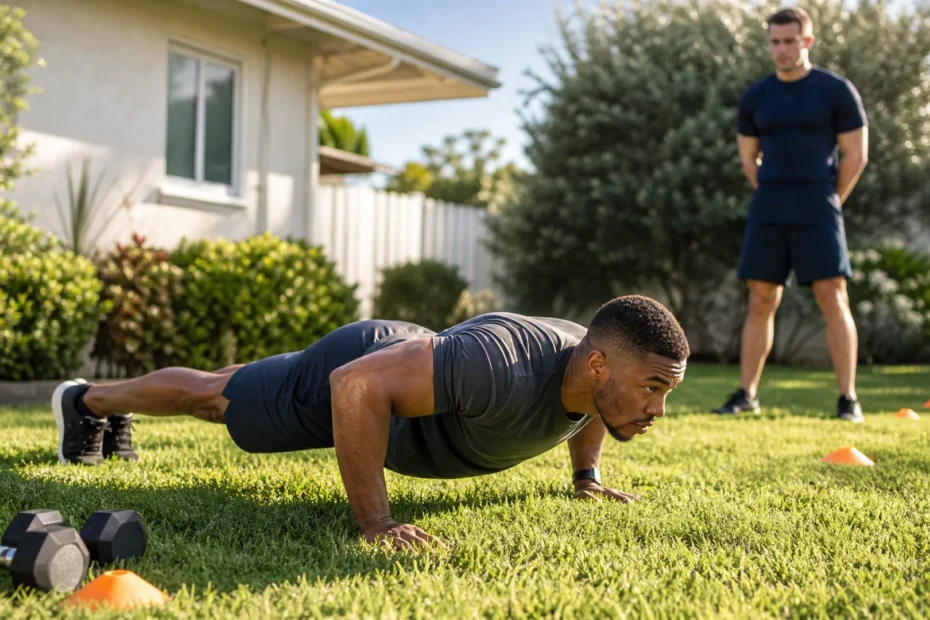
Applying for the police force is competitive enough without turning up to your fitness assessment underprepared. Most candidates who fail don’t fail because they’re unfit generally. They fail because they trained the wrong things, at the wrong intensity, with no one checking their form or pacing. A personal trainer for police fitness test prep fixes that gap. Fitness Inside Out trainers come to your home, a local park, or connect online, so recruits across Sydney, Central Coast, Wollongong, Melbourne and Brisbane can train for the police fitness test without needing a gym membership.
What Does the Police Fitness Test Actually Involve?
Police recruitment fitness tests in Australia typically assess a mix of aerobic capacity, muscular endurance, and agility. It’s not just about how hard you can run. It’s about how well you recover, how consistently you can repeat an effort, and how quickly you can change direction under fatigue.
Knowing the actual test structure matters more than following a generic “get fit” plan. Training with purpose, aimed at the specific components assessed, is what separates candidates who pass comfortably from those who scrape through, or don’t.
Beep Test, Push-Ups, Sit-Ups and Agility Explained
The beep test (multi-stage fitness test) measures aerobic fitness. You run between two points in time with a series of beeps that get progressively faster. Most police recruitment standards require reaching a specific level, and it’s usually the part candidates worry about most.
Push-ups and sit-ups assess muscular endurance rather than raw strength. You’re typically given a set time frame to complete as many correct-form reps as possible. Technique and pacing matter as much as strength here. Going out too fast burns you out before the clock runs down.
Agility runs test your ability to change direction quickly and under control, often via a shuttle-style course. This part rewards coordination and footwork as much as speed, so it responds well to specific drilling rather than just running longer distances.
Where ADF Fitness Test Requirements Overlap
If you’re also weighing up a Defence Force application, the good news is the training overlaps significantly. A personal trainer for ADF fitness test preparation works on the same core components: beep test level, push-up and sit-up endurance, and agility. That’s because the ADF’s basic fitness assessment structure closely mirrors what police recruitment tests for. Build a program around these fundamentals and you’re not choosing between one pathway or the other. You’re building fitness that transfers to both.
Why a Tailored Police Fitness Test Training Program Beats a Generic YouTube Plan
Search “how to pass the police fitness test Australia” and you’ll find dozens of listicles with the same generic advice: run more, do more push-ups, stretch beforehand. None of it accounts for your actual weak points or your actual test date.
A tailored police fitness test training program starts with an assessment of where you sit right now. If your beep test level is lagging but your push-ups are solid, your program should weight training toward the gap, not spread evenly across everything. If your test is six weeks away rather than four months away, your program needs to reflect that timeline realistically.
Generic plans also can’t correct your form in real time. If your push-up depth is inconsistent, or your shuttle-run turns are costing you time, a trainer sees that and fixes it on the spot. A YouTube video can’t watch you train.
How a Mobile Personal Trainer Preps You for the Police Fitness Test at Home, in the Park, or Online
You don’t need a gym membership to prepare properly. A mobile personal trainer for recruitment fitness test prep brings the program, the structure and the equipment to wherever suits you. Sessions can run from your driveway, a nearby oval, or entirely online if that fits your week better.
A tailored plan targets each test component separately: interval-style running to lift your beep test level, structured push-up and sit-up sets to build muscular endurance, and shuttle-run drills to sharpen agility and change-of-direction speed. That kind of specificity is hard to replicate on your own.
Training locally also means you can practise on similar surfaces and spaces to what you’ll face on test day, whether that’s outdoor training sessions in local parks or a flat stretch near home.
Training Options Around Work and Study Schedules
Recruits are often juggling shift work, study, or a current job while preparing for testing. A recruit balancing shift work or study can train early morning at home, squeeze in a session at a local park between commitments, or jump on an online session when travel isn’t possible.
That flexibility is the whole point of a come-to-you model. You’re not rearranging your life around a gym class timetable. The training fits around you. If in-person sessions aren’t always practical, you can still train for your fitness test online and stay on track.
Why Accountability Speeds Up Progress
Training for a fixed test date is different from general fitness. There’s a deadline, and it doesn’t move. An accountability partner who checks your numbers each week, beep test level, push-up reps, sit-up reps, agility times, keeps you honest about whether you’re actually progressing or just going through the motions.
That kind of structured tracking is one of the benefits of mobile personal training. Someone else is watching the trend line, not just the single session in front of them.
How Many Weeks Out Should You Start Training for the Police Fitness Test?
Most candidates need a genuine run-up of roughly eight to twelve weeks of consistent, progressive training. That’s what it takes to move up several beep test levels and build the push-up and sit-up endurance most recruitment tests require. The timeframe gives your aerobic system and your muscular endurance enough time to adapt properly, rather than forcing gains you can’t sustain on test day.
If your test is only a few weeks away, don’t panic and don’t skip this step. A trainer can still build you a compressed program focused on your biggest gaps first. It won’t be as comfortable a build-up, but focused, well-paced sessions in a short window still beat unstructured cramming.
If you’ve got several months before your test, that’s an advantage worth using. A longer lead-in lets a program build aerobic capacity gradually, which tends to produce more durable beep test improvements than a rushed final push.
Getting Fit for the Police Academy Whatever Your Starting Point
You don’t need to already be fit to start. Whether you’re currently sedentary, moderately active, or already training regularly, getting fit for the police academy is a matter of scaling the plan to where you actually are.
Fitness Inside Out has been running mobile and online personal training across Australia since 2001. That’s over two decades of experience adapting programs to different starting fitness levels and goals. Drills get scaled up or down safely. A beginner might start with walk-run intervals and modified push-ups, while a more active candidate jumps straight into beep-test-level intervals and full-rep sets.
The point is you’re never handed a program built for someone else. If you’re unsure what “beginner” versus “solid base” even looks like for these tests, that’s exactly what an initial assessment is for. It’s also worth understanding how to choose the right personal trainer if you’re comparing your options before committing.
Book Your Police Fitness Test Assessment Session
If you’ve got a test date locked in, or you’re just starting to think about applying, the smartest first step is an assessment session. A trainer can benchmark your current beep test level, push-up and sit-up counts, and agility, then build a program around your actual numbers and your actual timeline.
Fitness Inside Out covers Greater Sydney, Central Coast NSW, Illawarra NSW, Greater Melbourne and Brisbane, with in-home, local park and online sessions available depending on what works for you. For candidates specifically targeting police or Defence Force entry, our emergency services fitness training program is built around these exact test components.
You don’t need a gym membership, and if you’re in Sydney, you can also look at mobile personal trainers in Sydney for local, in-home coaching. You don’t need to already be at test-ready fitness. You just need a plan and someone holding you to it. Reach out through the contact page to book your assessment session and get a clear read on where you stand before test day. You’ll also see firsthand how staying fit without a gym membership can work in your favour.