
We come to you. That’s been the idea at Fitness Inside Out since Jacqueline Zonneveld and Jude Tarran founded the company in 2001. Our trainers visit homes, workplaces and local parks across Sydney, the Central Coast, Wollongong, Melbourne and Brisbane. Or they connect with you through a live online personal training session, from wherever you happen to be.
This guide walks you through how that works. You’ll see how to book, what to set up, and what actually happens on the call.
Online personal training explained: what makes a session live
A live session is real-time, coach-led video training. Your trainer is on the screen, watching you move, while you move.
That’s the whole difference. An app hands you a workout and leaves you to it. A pre-recorded program plays a video of someone else exercising. Neither can see your knees cave in on rep eight, and neither can tell you to fix it before rep nine.
In a live session, your coach spots the problem, says so, and adjusts the plan on the spot. If your energy is flat or your shoulder is niggling, the session changes with you.
It’s the same personal training, delivered through a screen instead of in your lounge room. Fitness Inside Out also offers 1-on-1, 2-on-1 and small group training, plus mobile exercise physiology, so online sits inside a wider range rather than standing alone.
Fitness for busy lifestyles: who online PT suits
You can train from your lounge room, your backyard or a hotel room on a work trip. There’s no commute, no parking, and no packing a gym bag you’ll never zip up.
That convenience matters most for a few types of people:
- Busy professionals who can fit 45 minutes around meetings, but not 45 minutes plus travel each way.
- Parents who can train while the kids are at school or after they’re in bed.
- Older adults who have lapsed at a gym and want coaching without walking back into one. Our look at home-based training for older adults goes deeper on this.
- Clients overseas, because we also serve people internationally.
If you’ve signed up to a gym before and quietly stopped going, you’re in good company. Our piece on why gym routines stall for busy people explains why, and why a set appointment with a real person tends to stick when a membership doesn’t.
Weight loss is a common goal for online clients too, and how online coaching works for weight loss covers that in detail.
Booking an online personal training session, step by step
Booking takes a few clear steps, and none of them need a gym visit. The whole process is built to get you from “I should do something” to a time in your diary quickly.
From first enquiry to your confirmed first call
- Enquire. Head to the page for online personal training with Fitness Inside Out and send your details.
- Share your goals. Tell us what you’re after, whether that’s weight loss, strength, getting moving again or staying active as you age.
- Mention injuries and health conditions. Your coach plans around them from day one, so be upfront about the old knee or the dodgy back.
- Give us your realistic availability. Realistic is the key word. A 5.30am slot you’ll skip is worse than a 7pm slot you’ll keep.
- Agree a first call and a recurring time. Once those are set, the sessions simply show up in your week.
Before that first call, do a quick tech check. Open the video link, test your camera and microphone, and stand where you plan to train.
Choosing a session time that fits your week
Pick a time you can protect, not one that only works when everything goes to plan. Many people land on early mornings, lunch breaks or after the school run.
It also pays to name a backup time for busy weeks. If Thursday’s session gets swallowed by a deadline, you already know Saturday morning is the fallback, and the week doesn’t slip away.
What equipment you need for online PT
Less than you’d think. You don’t need a home gym, and you don’t need to spend money before your first session.
Your online personal training setup: device, space and light
These are the must-haves:
- A device with a working camera and microphone, such as a phone, tablet or laptop.
- A reliable Wi-Fi or NBN connection.
- A clear patch of floor, roughly enough room to lie down and stretch your arms out.
- Light that faces you, so your coach sees you rather than a silhouette.
Where you put the device matters as much as what it is. Prop it so your coach can see your full body, head to feet, and keep a window behind the camera rather than behind you.
Simple extras and household swaps that cover most moves
A few cheap extras make sessions more varied. A resistance band, a mat, a pair of light dumbbells and a sturdy chair cover a lot of ground.
You don’t need to buy any of it up front, because household items fill the gaps. Filled water bottles stand in for light weights, a chair works for step-ups and supported squats, and a towel on a smooth floor makes a handy slider. Tell your coach what you’ve got and they’ll build the session around it.
This isn’t a route to heavy barbell work. If your main goal is lifting serious weight, you’ll eventually want more kit than a lounge room offers.
Video call personal training: how the coaching works on screen
Your coach can’t put hands on you. So the coaching comes from three things: what they see through the camera, what they say, and what they demonstrate.
That makes your camera setup part of the session, not just a technical detail. A good angle gives your coach more to work with.
How your coach reads your movement on camera
Good trainers look at the same things on screen as they would in a park. They watch your posture, your range of motion, your pace and how you breathe.
When they need a different view, they’ll ask. Expect requests like “turn side-on”, “step back so I can see your feet” or “slow that rep right down”. They’ll also demonstrate the movement themselves, so you have something to copy.
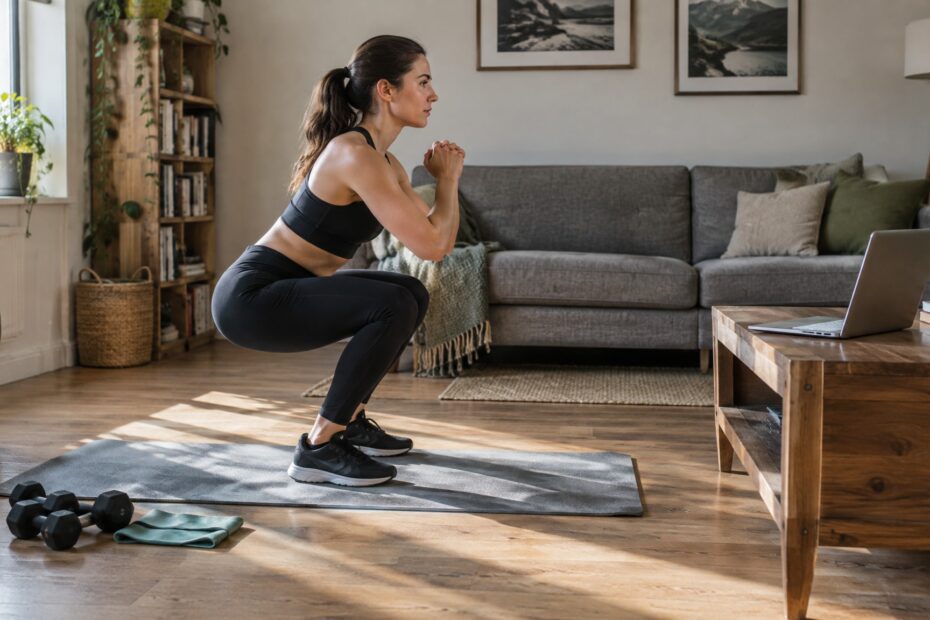
A typical session might go like this. Your trainer asks you to prop your phone at waist height so they can see your full body, then runs a short warm-up. When your squat looks off, they ask you to turn side-on and slow the way down. From that angle the fix is clear, and you feel the difference by the next set.
The online PT session format: warm-up, working sets and cool-down
Most sessions run in the same order:
- Warm-up. Light movement to get your joints and muscles ready.
- Working sets. The main part of the session, adapted to your space and equipment.
- Cool-down. Easing your heart rate down and stretching what you’ve worked.
- Check-in. A short chat about how you feel, what was tough and what’s next.
The working sets are where your coach earns their keep. If your room is small, they’ll swap lunges for a movement that stays in place. If you’ve got a band, they’ll use it.
Fixing common problems on a live video call
Most early snags are easy to prevent with that tech check before your first session. Even so, things go sideways occasionally, and a quick fix is usually all it takes.
Quick fixes for lag, audio and camera angles
- Laggy video: Move closer to the router, or close other apps and streaming on your network.
- Dropped audio: Check your microphone permissions, or plug in earphones.
- Camera cutting off your feet: Lower the device and tilt it back, or step further away.
- Cramped room: Tell your coach early, and they’ll choose moves that fit the space.
- Time-zone mix-ups for overseas clients: Confirm each session time in your own local time, and check it again when daylight saving changes.
If a problem keeps coming back, say so. Your coach would rather rework the setup than watch you struggle through a bad connection.
Online or in-person: which format suits you
Choose on fit, not on what sounds best. A live online session works well when you want coaching from wherever you are and a setup that survives travel, school pick-ups and long work weeks.
In-person training has its own strengths. A trainer standing beside you can adjust your grip, guide your hips or steady a movement by hand. If you’re learning a tricky lift, rehabbing an injury or need that physical guidance, in-person sessions that come to your door may be the better call. Fitness Inside Out also offers mobile exercise physiology for people who need that level of care.
Still weighing it up? Our comparison of online versus in-person personal training sets the two side by side.
Who gets the most from a live online session
You’ll likely get the most from a live online session if you:
- Train best with a set appointment and a coach holding you to it.
- Live outside the areas where our trainers travel, or move around for work.
- Are comfortable setting up a device and a bit of floor space.
- Want technique feedback and accountability more than hands-on adjustment.
It’s not the best fit if you need physical hands-on correction for most of your session. In that case, start in person.
Ready to try it? Book your first live online session through the Online Personal Training page, and your coach will take it from there.
Frequently asked questions
Do I need gym equipment for online personal training?
No. A phone, tablet or laptop, a clear patch of floor and good light are the essentials. A resistance band and mat help, and filled water bottles and a sturdy chair cover plenty of moves. Tell your coach what you have and they’ll plan around it.
What happens if my internet drops mid-session?
Rejoin the call as soon as you can and let your coach know what happened. A quick tech check before your first session catches most causes, such as a weak Wi-Fi spot. If it keeps happening, tell your coach so you can sort out a more reliable setup together.
Can I do online personal training with an injury or health condition?
Yes, and you should mention it when you enquire so your coach can plan around it from the first session. Live video lets them adjust moves as they watch you. If you need hands-on guidance to recover, in-person training or mobile exercise physiology may suit you better.
Can I train with Fitness Inside Out from overseas?
Yes. We serve clients internationally through live online sessions. The main thing to sort out is a session time that works across both time zones, so confirm each time in your local time.
Is online personal training as good as training in person?
It depends on your goal. For accountability, coaching on form and fitting training into a busy week, live online sessions work very well. For hands-on technique work, such as learning a complex lift, in-person coaching has the edge.