
Deciding between a personal trainer and a gym membership means looking beyond the monthly fee. Plenty of busy Australian adults sign up for gyms with the best intentions, then watch commuting, crowded peak hours and generic equipment layouts quietly erode their consistency. The real comparison isn’t access to machines. It’s whether you have the structure, accountability and convenience to turn exercise into a habit instead of another cancelled appointment.
Why Traditional Gym Memberships Often Fail Busy Adults
Having a fully equipped facility at your disposal doesn’t guarantee progress. Access alone rarely holds up once work and family demands pile on. Why gym memberships fail busy people usually comes down to a mismatch: rigid venue hours against a schedule that changes every week.
The hidden costs of unused memberships
The wasted money is the obvious problem. The quieter one is psychological, paying for a service you can’t use breeds a negative association with exercise itself. Once your membership feels like a monthly guilt tax rather than an investment, you’re far less likely to go back after a lapse. A scheduled coaching session, by contrast, creates a positive obligation that protects your time and your mental energy.
When convenience beats equipment access
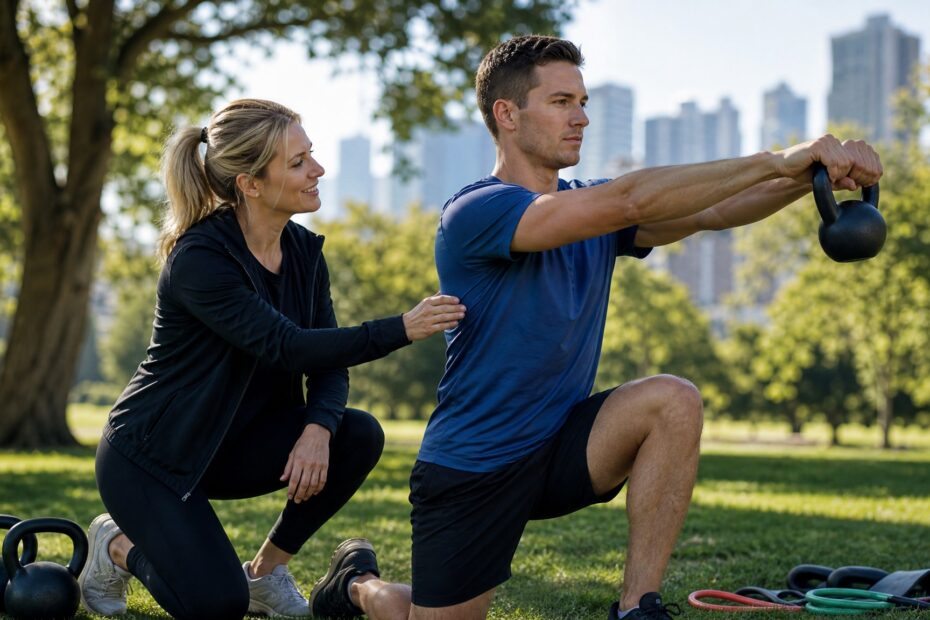
Mobile personal training removes commute friction by bringing equipment and expertise directly to your home, local park or workplace. Cut the travel time and a ninety-minute logistical ordeal becomes a focused forty-five-minute session. Consistency stays possible even during your busiest professional or parenting stretch.
Personal Trainer vs Gym Membership Cost Breakdown in Australia
Weighing the financial commitment means telling apart an expense that drains your account from an investment that pays off in actual health returns. A gym offers cheap entry, but the return sits at zero if your attendance drops below what your body needs to adapt. The cheaper option can end up the most expensive one.
Understanding hourly rates and package value
The Australian Institute of Personal Trainers indicates that most personal trainers in Australia charge between $40 and $90 an hour, according to Medibank Live Better. The factors influencing personal trainer costs include the trainer’s experience, location and specialisation, so treat that range as a baseline for budgeting, not a fixed tariff.
Comparing long-term investment against monthly fees
A gym membership charges you for potential access. A personal trainer charges for guaranteed execution and expert guidance during every minute you train. Calculate cost per effective workout rather than monthly overhead, and coached sessions often come out ahead, because they skip the wasted months of trial and error that come with training on your own.
Accountability and Real Outcomes: Gym vs Personal Trainer Results
Hiring a professional shifts the planning and execution of your workouts off your tired mind and onto an expert managing your progression. That shift is what separates people who get gym vs personal trainer results from people stuck starting and stopping.
How external accountability drives consistency
Willpower runs out as a demanding workday wears on, which leaves self-directed training vulnerable to fatigue and decision paralysis. A scheduled session with a coach is a non-negotiable anchor in your week. It gives you the external structure to keep moving when motivation inevitably dips.
Tailored programming versus generic gym routines
Fitness instructors often serve as entry-level roles, whereas personal trainers hold advanced responsibilities for tailored programming and client outcomes, as noted by the ACFPT. Your coach adjusts volume, intensity and exercise selection in real time based on how your body responds. Every session builds on the last instead of repeating random movements that lead to plateaus.
Measuring progress beyond the scale
Real fitness includes movement quality, pain reduction and functional capacity. A bathroom scale can’t capture any of it. Professional coaching gives you objective feedback on these improvements, so you recognise strength and resilience gains well before any aesthetic change shows up.
Mobile PT vs Gym Membership: Training Where Life Happens
For many professionals and parents, the choice between home training and a gym comes down to logistics, not preference. Since 2001, Fitness Inside Out has delivered mobile and online training across Sydney, Melbourne, Brisbane and regional NSW to clients who struggle with traditional gym consistency. Bringing the service to the client solves the adherence problem at its root.
How mobile personal training works makes clear this isn’t a luxury convenience. It’s a strategic fix for people whose lives don’t fit around a fixed venue. Your trainer arrives with all the equipment and a plan built for your actual space, so there’s no environmental excuse left to derail a solo effort.
This approach treats your time as a valuable asset and folds fitness into your existing routine, rather than forcing you to carve out separate blocks for travel and the changing room. You get professional-grade coaching without peak-hour traffic or waiting for equipment, which makes the mobile PT vs gym membership debate largely irrelevant if you’re prioritising efficiency.
Online Personal Training vs In-Person Coaching
Digital coaching has moved well past pre-recorded videos. It now offers live interaction that keeps accountability intact while giving you geographic flexibility. To compare online and in-person formats properly, work out whether you need hands-on correction or structured programming with remote oversight.
When live virtual sessions bridge the gap
Live online sessions give you real-time form checks and motivational cues that a static app can’t replicate for complex movements. This format suits people who are disciplined enough to execute safely without physical spotting, but still want programming expertise and verbal accountability.
Hybrid models for flexible lifestyles
Combining periodic face-to-face assessments with regular virtual check-ins gives you a middle ground: technical refinement alongside scheduling freedom. This hybrid approach keeps your momentum going during travel or illness, while still giving you the hands-on corrections that prevent injury and build long-term technique.
Is a Personal Trainer Worth It for Your Specific Goals?
Whether a personal trainer is worth it depends on whether your goals need specialised knowledge that general gym staff can’t legally or practically provide. Generic advice is fine for general maintenance. Specific outcomes need targeted expertise, and that’s what justifies the extra cost.
Weight loss and body composition
Sustainable fat loss needs nutritional alignment and metabolic conditioning that adapts as your body changes. A static machine circuit can’t do that. A coach works through the inevitable stalls and adjustments, which heads off the frustration that causes most people to give up on weight loss in the first three months.
Injury recovery and exercise physiology
Rehab needs precise loading that sits safely between rest and aggravating stress, a zone where general gym instructors lack the qualifications to operate. Accredited exercise physiologists design programs that respect tissue healing timelines while rebuilding confidence, so you recover function without risking re-injury through well-meant but misguided effort.
Strength training for over 40s and seniors
Ageing bodies need modified recovery protocols and joint-friendly exercise choices that preserve muscle mass without compromising structural integrity. Professional guidance helps you build functional strength that supports independence and daily activities, because training later in life has its own physiological realities, not a younger person’s template.
Choosing the Right Path for Your Lifestyle
Base your decision on an honest read of your current discipline, available time and specific health needs, not on aspirational ideals. If you’ve repeatedly lapsed at the gym despite good intentions, the issue is likely environmental friction rather than personal failure. Change the delivery model and you’ll likely get a different result.
Mobile and online coaching suit people who need professional structure built into their actual lives. Gym memberships suit self-starters with predictable schedules and established technique. Neither is universally better. The right path is the one that matches your reality and removes the specific barriers that have stopped you before.
If you’re ready to explore whether mobile, online or small group training fits your situation better than another gym contract, book a free consultation to talk through your goals with our team. The conversation costs nothing, and it gives you the clarity to stop guessing and start training in a way that actually sticks.
Frequently asked questions
Is it good to have a personal trainer in the gym?
Yes, if you struggle with program design or technique confidence amidst distracting gym environments. A trainer provides focused attention that floor staff cannot offer, ensuring your gym time translates to actual progress rather than wandering between machines. However, if commute friction is your main barrier, a mobile trainer visiting your home may solve the consistency problem more effectively.
What is the 3-3-3 rule for training?
The 3-3-3 rule typically refers to performing three exercises, for three sets each, three times per week as a minimalist strength framework. This structure suits busy beginners who need simplicity over complexity, though it lacks the periodisation that prevents plateaus over longer terms. A personal trainer can determine if this basic template suffices for your goals or if you require more nuanced programming.
Is it better to have a home gym or gym membership?
A home gym wins on convenience and eliminates travel time, making it superior for time-poor adults who value consistency over equipment variety. A gym membership offers broader machine selection and social atmosphere, which benefits those who need external stimulation to train hard. For many, mobile personal training bridges this gap by bringing professional equipment and coaching directly to your home without the capital outlay.
What’s the difference between a personal trainer and a fitness trainer?
Personal trainers hold advanced qualifications allowing them to design tailored programs for specific health conditions and complex goals. Fitness trainers or instructors typically possess entry-level certifications suited for supervising gym floors and teaching pre-choreographed classes. If you require rehabilitation, postnatal support, or customised progression, a personal trainer or exercise physiologist is the appropriate professional.