
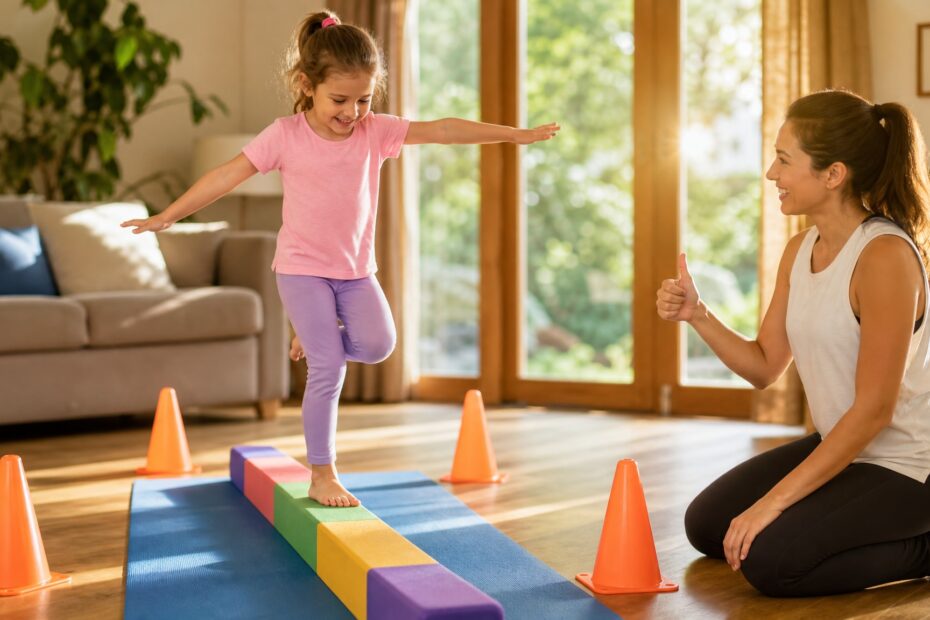
Australian guidelines recommend kids aged 5 to 12 get at least 60 minutes of moderate to vigorous physical activity every day. Many don’t get there on school sport alone. A personal trainer for kids at home closes that gap by bringing structured movement straight to your doorstep, without the pressure of a gym or a competitive team environment. The focus stays on fundamental movement skills and confidence rather than performance metrics, which is what builds a positive association with exercise that can last a lifetime.
Why Hire a Personal Trainer for Kids at Home?
You might worry that exercise will feel like another chore on an already packed schedule. A dedicated kids fitness coach at home flips that: it turns physical activity into something your child actively looks forward to rather than endures. Training in your own space removes the social anxiety that comes with public sporting fields or crowded rec centres, so younger children can focus on learning new skills without an audience.
Building Confidence Through Movement
Confidence in young kids comes from mastery, not competition, and private coaching means repeated success in a controlled setting. A personal trainer for children Australia-wide knows that developmental milestones vary a lot between ages five and twelve, so sessions get tailored to your child’s current capabilities rather than measured against some arbitrary standard. Every small win gets noticed and reinforced. That’s how a kid who’s always felt clumsy or uncoordinated starts to build real self-belief through challenges they can actually clear.
Safety and Supervision in a Familiar Space
Home is a predictable environment where the risks are known and manageable, and that matters when you’re introducing structured exercise to younger kids. Mobile trainers adapt their programming to your surroundings, so fun home workouts for kids stay safe whether you’re in the living room, the backyard, or the park down the road. That familiarity also helps kids settle into a session faster, since they’re not trying to learn new movement patterns in an unfamiliar facility on top of everything else.
What Does a Kids Fitness Coach Actually Do?
In-home fitness for kids is about fundamental movement skills, not adult-style outcomes like muscle size or cardio endurance targets. Coaches build balance, coordination, agility and spatial awareness through activities that feel like play but are grounded in paediatric exercise science.
Age-Appropriate Programming vs Adult Training
Training for kids under 13 looks nothing like teenage or adult personal training, because growing bodies need different stimuli and different safeguards. Older adolescents might work with resistance training and external loads. Younger kids get more out of bodyweight movements, obstacle courses and skill-based drills that build neuromuscular connections without stressing developing growth plates. A qualified kids exercise coach won’t just shrink an adult program down to size. They’ll use progressions built around where a child actually sits, physically and developmentally.
Gamification and Engagement Strategies
Holding a young child’s attention takes creative programming that hides the effort inside a game. Coaches use cones, beanbags, parachutes and reaction lights to build games that challenge several movement patterns at once while keeping things light. Kids end up working hard without noticing, building fitness and skill through their own motivation rather than because someone told them to.
In-Home Fitness for Kids: Logistics and Setup
Most parents assume a session needs more space than it actually does. Mobile trainers are used to working with compact indoor rooms and irregular outdoor spaces, and a clear area roughly three metres by three metres is usually enough for most fundamental movement drills. Your trainer will check the space during the initial consultation to confirm it’ll work before you commit to a regular schedule.
Space Requirements for Indoor and Outdoor Sessions
Indoor sessions work in living rooms, garages or rumpus rooms, as long as there’s enough ceiling height and floor clearance for dynamic movement. Outdoor options include backyards, driveways or local parks, and the trainer picks the venue based on weather and what’s planned for the day. You don’t need a dedicated home gym or a big property. Your existing space is usually more than enough once someone knows how to use it.
Equipment Provided by Mobile Trainers
Mobile trainers work with clients across Sydney, Central Coast, Wollongong, Melbourne and Brisbane, bringing coaching to backyards and living rooms instead of asking anyone to show up at a gym. Your coach turns up with all the age-safe equipment needed, so there’s nothing for you to buy or store. The only thing you need to do is have the space clear and ready at session time.
Choosing the Right Personal Trainer for Children in Australia
Picking a safe, effective coach means checking credentials that go beyond a standard adult fitness qualification, because paediatric exercise calls for specific knowledge of growth and development. When choosing the right personal trainer for your child, confirm they hold current First Aid and CPR certification along with a state-specific Working With Children Check. Neither is optional for anyone supervising minors in Australia.
Essential Qualifications and Working With Children Checks
A valid Working With Children Check, or the equivalent state screening such as a Blue Card in Queensland, is the baseline. Ask to see it before the first session. Beyond that mandatory screening, look for coaches who’ve done extra coursework in youth fitness, paediatric exercise science or motor learning. That’s what separates genuine expertise from generic personal training knowledge applied down an age bracket. Fitness Inside Out was founded in 2001 by Jacqueline Zonneveld and Jude Tarran, and that’s more than two decades spent delivering mobile personal training directly to Australian homes.
Experience with Paediatric Exercise Science
An adult fitness qualification doesn’t automatically make someone safe to coach kids. Ask specifically about a trainer’s experience with children under 13. Practical experience counts for as much as formal education here, because reading fatigue cues and modifying exercises on the fly for developing bodies is something you learn by doing it, not from a textbook. If your kids are older, personal training for teenagers is a separate service built around adolescent physiology and goals.
Family Personal Training and Sibling Options
Sessions come in 1-on-1, 2-on-1 and small group formats, so you can choose the level of individual attention and social interaction that suits your child. Pairing siblings or friends can make sessions more affordable, and it builds in a bit of social motivation that keeps kids accountable to each other between visits.
2-on-1 Sessions for Siblings or Friends
Can siblings train together? 2-on-1 training sessions hit a sweet spot: kids still get real individual feedback, but they also get peer encouragement and cooperative games. It works especially well for siblings close in age or friends who push each other, because the shared experience takes the intimidation out of it and makes showing up feel social rather than obligatory.
Integrating Parents into the Routine
Some families run parent-child sessions together, with adults joining in alongside their kids. It models healthy behaviour and gets more value out of the trainer’s visit. This also shows kids that fitness isn’t something you outgrow, and it gives you a firsthand look at how the coach works. Even if you’re not training alongside them, watching part of a session lets you reinforce what the coach is teaching and celebrate progress the same way they do.
Online vs In-Person Coaching for Younger Children
Does online personal training work for young kids the way in-home sessions do? For kids under 13, live online supervision is best as a supplementary tool, useful over holidays or travel, rather than a primary teaching method. Younger learners need physical presence for form correction, hands-on cueing and sustained engagement in a way a screen can’t replicate. Video sessions can hold a routine together during a disruption, but the actual skill acquisition and habit formation behind good kids fitness programs comes from face-to-face mobile training, where the coach can adjust positioning, show a technique physically, and pick up on non-verbal cues a screen hides.
Getting Started with Mobile Kids Fitness
Onboarding usually starts with a movement assessment and a goal-setting chat that includes both parent and child, so everyone knows what to expect and how progress gets measured. That first session is deliberately low-pressure and built around rapport, because long-term adherence depends on your child feeling comfortable and excited, not tested. To talk through your child’s needs and check trainer availability in your area, reach out for a no-obligation consultation, ask your questions, and see if it’s the right fit before committing to anything.