Preparing for the Australian Defence Force takes a specific type of fitness that general gym routines rarely deliver. You might run 5km easily or bench press your body weight, and still fail the Basic Fitness Assessment because your push-up depth was short or your beep test pacing was off by three seconds. A personal trainer for the ADF fitness test at home bridges that gap. They bring military-specific conditioning to your driveway or local park, cut the travel time, and make sure every minute of training targets the exact standards recruiters enforce during the 2026 and 2027 intake cycles.
This service isn’t for people chasing general weight loss or bodybuilding aesthetics. It’s for candidates who need to pass a standardised physical employment assessment.
Understanding Current ADF Fitness Assessment Standards
The ADF doesn’t grade on effort or improvement. You train against fixed benchmarks that decide whether you go to recruit school or get sent home. Know these numbers before your first max-effort set. Guessing wastes months and risks injury.
Push-Up and Sit-Up Minimum Requirements by Age and Gender
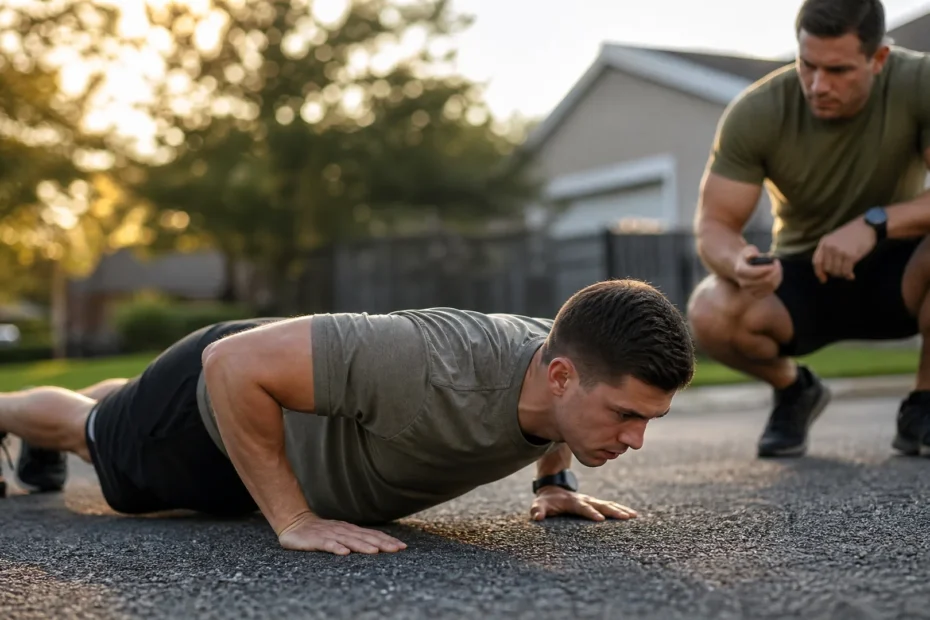
ADF fitness assessments strictly enforce form. Push-ups must reach 90 degrees at the elbow, and sit-ups require your fingers to stay interlocked behind your head throughout the movement. Recruiters count only reps that meet this standard, so twenty perfect push-ups score higher than fifty sloppy ones that get called out. Minimums vary by age bracket and gender: male recruits aged 18–24 typically need around 30 consecutive push-ups and 45 sit-ups, while female recruits in the same cohort generally need 15 push-ups and 45 sit-ups for general entry. These baselines shift as you move into older age brackets, but the form criteria never relax.
Beep Test Levels for Army, Navy, and Air Force Entry
The beep test remains the primary aerobic capacity assessment for all three services. Entry levels typically range from 6.1 to 10.2 depending on the role and your gender. Infantry and combat engineer candidates face the highest thresholds, often needing level 10.2 or above, while many logistics and administrative roles accept scores between 6.1 and 7.5. You can’t substitute a 2km run time or a VO2 max estimate for this shuttle run protocol, the acceleration and deceleration demands are nothing like steady-state cardio. Train for the wrong level and you waste energy. Underestimate the required score and you risk failing on test day, when nerves already have your heart rate up.
Why Generic Gym Programs Fail Military Recruits
Standard commercial gym programming chases muscle size or general cardio health, not the repetitive sub-maximal endurance military testing demands. You can have real strength and still fail the assessment, because your muscles are conditioned for sets of eight to twelve reps rather than continuous tension lasting two minutes or more. Commercial trainers without defence experience often build in rest intervals that are too long. They don’t replicate the cumulative fatigue that causes candidates to drop out during the final stages of the beep test or the push-up component.
Recruits who try to self-coach often fail because they train for general fitness rather than test-specific pacing. Professional coaching bridges the gap between being “fit” and being “test-ready.” Passing means mastering the cadence of the audio prompts and the biomechanics of efficient rep cycling, and neither of those comes from random workouts or treadmill sessions. Without feedback on your elbow angle or your shuttle turn, you can drill the wrong movement pattern for weeks and only find out when it’s penalised on test day.
How a Mobile Personal Trainer Builds Your ADF Program at Home
A mobile trainer cuts the commute to a gym and brings equipment and expertise calibrated to defence recruitment standards. You get structured emergency services fitness training in your own environment, so you keep up with work and study while you prepare. This matters most in outer suburbs, where specialist military prep coaches are thin on the ground.
Adapting Beep Test Training for Parks and Driveways
Fitness Inside Out mobile trainers run outdoor beep test simulations in local parks using calibrated audio and marker cones, replicating the official testing environment for recruits across Sydney, Melbourne, and Brisbane. You don’t need an athletics track or an indoor court to build shuttle run capacity. Trainers pick flat, safe outdoor training locations near your home and bring portable speakers set to the exact tempo and timing of the official test recordings. Training on variable surfaces and in real weather builds adaptability that candidates stuck in climate-controlled gyms don’t get.
Equipment-Free Push-Up and Sit-Up Progressions
Military fitness testing needs no equipment beyond your body, so your prep should be just as simple. No machines to mask weaknesses. A qualified coach adjusts leverage, tempo, and volume to progressively load your pressing and core endurance without any external weight. Can’t yet hit the minimum push-up count? They’ll prescribe incline variations or eccentric-only phases that build connective tissue tolerance safely. Sit-up progressions focus on hip flexor endurance and neck position, since that’s usually what causes the cramping that ends attempts early.
Scheduling Sessions Around Work and Study Commitments
Enlistment prep competes with your job and your studies, which is why rigid class schedules don’t work for most adult candidates. The benefits of mobile personal training include flexible timing around shift work, lectures, and family commitments, so you’re not forced to choose between income and readiness. Early morning, evening, and weekend slots let you train consistently even during busy academic or work periods. Consistency beats session length when you’re building the aerobic base and muscular endurance the test demands.
Sample Timeline: From Baseline to Test-Ready
Rushing preparation raises your injury risk and hurts retention, so a realistic plan starts with an honest read on your current fitness against the entry standards. Most candidates with moderate baseline fitness need eight to twelve weeks of targeted training to close the gap safely. Starting from a sedentary background can mean four to six months. Try to compress that timeline and you’re looking at shin splints, stress fractures, or tendonitis, which delays enlistment further anyway.
Weeks 1–4: Building Base Endurance and Technique
This phase is about movement quality and low-intensity volume, nothing else. It’s the foundation the later, harder weeks depend on. You learn push-up depth, sit-up rhythm, and shuttle turn mechanics before adding speed or distance. Aerobic development happens through longer, slower efforts that build capillary density without loading you up for overuse injuries. This period feels deceptively easy. Skip it and you’ll hit a plateau, or break down, once the training load increases.
Weeks 5–8: Intensity, Pacing, and Mock Testing
Once your body has adapted to the movement patterns and the base workload, training shifts to test-specific intervals and full simulation runs. You practise beep test pacing that conserves energy in the early levels while holding your position through the tough middle stages, where most failures happen. Push-up and sit-up sessions bring in timed sets that match or beat the official test duration, building tolerance for the discomfort. Regular mock assessments give you real numbers to work from as you fine-tune what’s left of your preparation window.
Accountability and Progress Tracking for Enlistment Goals
Self-guided prep runs into confirmation bias: candidates overestimate their readiness because they unconsciously ease off on form or skip the hard components when training alone. A dedicated coach keeps that honest and keeps progress measurable, session to session. Recorded mock test scores build an evidence trail showing whether you’re trending toward a pass or need more time before you book the official assessment. That data stops the costly mistake of turning up to testing unprepared because you talked yourself into being ready.
Regular check-ins also catch things like asymmetric fatigue or slipping technique before they turn into an injury. Adjusting the load based on how you’re actually performing beats following a static spreadsheet that has no idea about your sleep, your stress, or the cold you had last week. Professional oversight turns “I feel tired” into an actual programming decision that keeps you on track for your enlistment date.
Choosing the Right Military Fitness Coach in Australia
Not every personal trainer understands defence recruitment standards, and hiring one without ADF-specific experience wastes your money and your time. You need a coach who can cite current minimum scores, explain the form criteria that get you disqualified, and build programs around the official testing protocol rather than generic fitness principles. Ask prospective trainers how many recruits they’ve prepared and what pass rates those candidates achieved. A general certification doesn’t guarantee competence here, where the margin between pass and fail is measured in centimetres and seconds.
Verifying Experience with Defence Recruitment Standards
Qualified military fitness coaches stay current with policy changes and keep relationships with recruiting staff so they know what’s actually expected. They should be able to explain the difference between general entry standards and the role-specific benchmarks for your intended corps or trade on the spot. Ask for examples of past client progress, or references from candidates who passed and can vouch for the method. If a trainer can’t articulate specific ADF requirements, or lumps military testing in with police fitness test preparation, they probably don’t have the specialised knowledge your enlistment depends on.
Service Areas Across Sydney, Melbourne, and Brisbane
Whether mobile training works for you comes down to where you live and when you’re free. Fitness Inside Out serves Greater Sydney, Central Coast NSW, Illawarra NSW, Greater Melbourne, and Brisbane with trainers experienced in defence candidate preparation. Outside those metro areas, you may need to combine remote programming with periodic in-person sessions to keep your form and pacing on track. Confirm coverage in your specific suburb before committing, travel surcharges or availability limits can affect how consistent you’re able to stay.
Next Steps to Secure Your ADF Fitness Preparation
Waiting until you “feel ready” to start usually means starting too late. Fitness adaptations take biological time, and no amount of willpower speeds that up. Book a baseline assessment now and you get your true starting point plus a personalised timeline built around your target enlistment window. That first session identifies specific weaknesses in push-up depth, sit-up endurance, or shuttle run efficiency that a generic program would miss. You leave with real data and a structured plan, instead of continuing to guess whether your current routine is enough.
Contact Fitness Inside Out to book your baseline assessment with a mobile trainer who specialises in ADF recruitment standards. Start early and you build in the buffer to handle setbacks without putting your application timeline at risk. Start late and that buffer disappears, and you’re left cramming, which is where most failures and injuries happen.