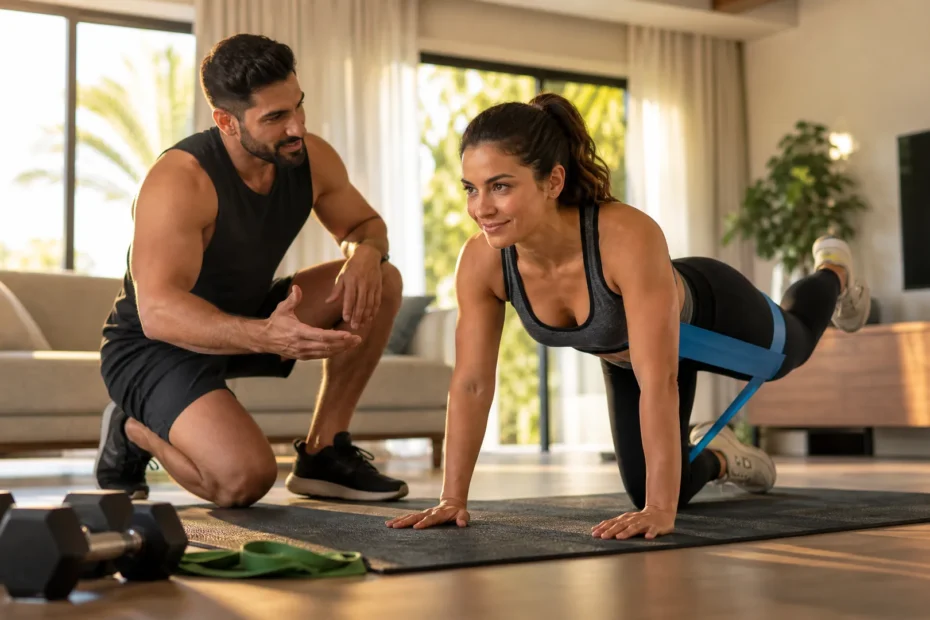
More Australians are ditching gym memberships for a simpler idea: the trainer comes to you. Mobile personal training brings a qualified coach to your home, your office, your local park, or your screen. Your workout fits your life instead of the other way around. It’s one of the clearest benefits of mobile training over the traditional gym model, and it’s why busy professionals, parents, and older adults across Australia are making the switch.
Fitness Inside Out has delivered mobile and online personal training across Sydney, Central Coast, Wollongong, Melbourne, and Brisbane since 2001, built entirely around the come-to-you model. That track record gives a useful lens for what actually changes when a trainer meets you where you are, instead of expecting you to meet them at a gym.
This article breaks down nine practical mobile personal training advantages, compared directly against the gym experience, so you can decide what fits your goals.
What Is Mobile Personal Training, and Why Are More Aussies Choosing It?
Mobile personal training means a certified trainer travels to a location that suits you. That might be your living room, your backyard, a park near your office, or a quiet corner of your workplace gym. Sessions can also run online, giving you a fully flexible option if you travel often or live outside a trainer’s usual driving radius.
The appeal is straightforward. Traditional gyms ask you to fit your life around their opening hours, their location, and their equipment queues. Mobile training flips that. You choose the time, the place, and often the format. The trainer brings the equipment, the program, and the expertise.
Gym vs Mobile Personal Trainer: The Key Differences
A gym membership gives you access to a shared space, shared equipment, and sometimes a rotating cast of trainers. A mobile personal trainer gives you one dedicated coach, a session built around your specific goals, and a location you control.
You’re not sharing a squat rack or waiting for a bench to free up. You’re not driving across town before or after work. The session starts the moment your trainer arrives, and every minute goes toward you.
Convenience and Time-Saving: The Biggest Mobile Personal Training Advantages
For most people, time is the real barrier to consistent exercise. Convenience is the strongest of all the mobile personal training advantages, because it removes the single biggest reason people skip workouts.
No Commute, No Wasted Time
Driving to a gym, parking, changing, waiting for equipment, then reversing all of that afterward can easily add half an hour to a session. Mobile training removes every one of those steps.
Your trainer arrives at your door with everything needed for the workout. You spend more time actually training and far less time getting there.
Training That Fits Around Your Schedule, Not the Gym’s
Gyms operate on fixed hours. A mobile trainer works around your calendar, whether that’s a 6am session before the kids wake up, a lunchtime slot near the office, or an evening session once work wraps up.
For busy professionals and parents juggling school runs, this kind of scheduling flexibility is often the difference between training consistently and not training at all.
No Gym Anxiety: In-Home Personal Training Benefits for Confidence
Gym intimidation is a real and common reason people avoid exercise altogether. Feeling watched, unsure how to use equipment, or self-conscious in a busy weights room stops plenty of capable people from ever starting.
In-home personal training benefits are especially strong here, because the entire environment changes. There’s no crowd, no mirrors lining every wall, and no sense of being compared to anyone else in the room.
Training in a Private, Judgement-Free Space
Plenty of new gym memberships lapse within the first few months. Intimidation, inconvenient locations, and inconsistent attendance are usually to blame, and they’re the exact frictions the mobile model is built to remove.
When training happens in your own home or a quiet park, that pressure disappears. Beginners, older adults, and teens in particular tend to open up and push harder once they’re not worried about being watched.
Personalised Attention and Consistency and Accountability
Group classes and busy gym floors rarely let a trainer focus fully on one person’s technique, pacing, or progress. Mobile training is built around undivided, one-on-one attention every single session.
Why 1-on-1 Coaching Gets Better Results Than Group Gym Classes
In a group class, a trainer watches ten or twenty people at once. In a mobile session, they’re watching you. That means real-time form corrections, programming built around your actual goals, and adjustments made on the spot when something isn’t working.
If you’d rather share the motivation and cost with someone else while still getting close attention, training with a friend or partner in a 2-on-1 session is worth considering too.
How Mobile Trainers Keep You Consistent Week to Week
Consistency drives results, and it’s where most people struggle most. When a trainer is booked to arrive at your door at a set time each week, that appointment is far harder to skip than a vague plan to “get to the gym.”
Busy Sydney mums who’ve lapsed on gym memberships for years often stick with a program for the first time once a trainer starts showing up at their front door each week. That simple shift, from “I should go” to “someone is coming,” changes behaviour in a way that gym access alone rarely does. If you’re curious about what a typical visit looks like, it helps to understand how a personal trainer that comes to your home actually works before your first session.
Personal Trainer at Home vs Gym: Comparing the Value
Comparing a personal trainer at home vs gym membership isn’t just about cost. It’s about what you actually get for the time and effort you put in.
A gym membership gives you access to a space and equipment. But you still need to travel there, navigate it alone between sessions, and hope the trainer you’re assigned is the right fit. Mobile training includes the equipment brought to you, a program built specifically around your goals, and no lock-in gym contract sitting in the background.
There’s also no wasted travel cost or time spent driving to and from a facility. Every session is used efficiently, because the setup, the coaching, and the pack-down all happen in the one visit. For anyone still weighing up formats, it’s worth reading through how to choose the right personal trainer in Australia before committing either way.
Who Benefits Most from Mobile and Online Personal Training?
Mobile and online personal training suits a wide range of people, but a few groups tend to benefit the most from the flexibility it offers.
Busy Parents, Over 50s, and Teens at Home
Busy parents often can’t commit to a fixed gym class time around school pickups, meal prep, and work. A trainer arriving at home removes that scheduling conflict entirely, and there’s a dedicated approach to personal training designed for busy Sydney mums built around exactly this challenge.
Adults over 50 often want a program that respects joint health, past injuries, and pace, without the noise and crowding of a typical gym floor. Personal training tailored for older adults works well in a home setting where mobility, safety, and comfort come first.
Teens training at home, meanwhile, avoid the self-consciousness that can come with a busy public gym during peak after-school hours.
Clients recovering through exercise physiology or managing NDIS support plans benefit from sessions held in their own home, where mobility aids, equipment, and routine are already familiar. For these clients, NDIS personal training support delivered at home keeps therapy and fitness goals working together in a familiar setting.
Founders Jacqueline Zonneveld and Jude Tarran built Fitness Inside Out in 2001 around the idea that professional coaching should fit into a client’s life, not the other way around. That founding principle still shapes how sessions are delivered for these audiences today.
When Online Personal Training Makes Sense
Online coaching is a natural extension of the mobile model for anyone who travels frequently, lives outside a trainer’s usual driving area, or simply prefers training from home on a screen. You still get a structured program, regular check-ins, and real accountability, just delivered remotely.
The coaching quality doesn’t have to drop with the format. A trainer who understands your goals and history can deliver the same standard of programming and feedback through online personal training options as they would standing beside you in person, provided the communication and check-in structure is solid.
Getting Started with Mobile Personal Training
The core benefits of mobile personal training all come back to one idea: fitness should fit your life, not compete with it. No commute, no crowd, no lock-in gym contract, and no wasted time getting to a workout that could start the moment your trainer walks through the door.
Whether you’re a busy parent short on time, an over-50s client wanting a safer pace, a teen who’d rather train at home, or someone managing an NDIS plan, the come-to-you model removes the frictions that usually get in the way. Booking a free consultation with a mobile personal trainer is a low-pressure way to see whether this approach is the one that finally gets you consistent.