
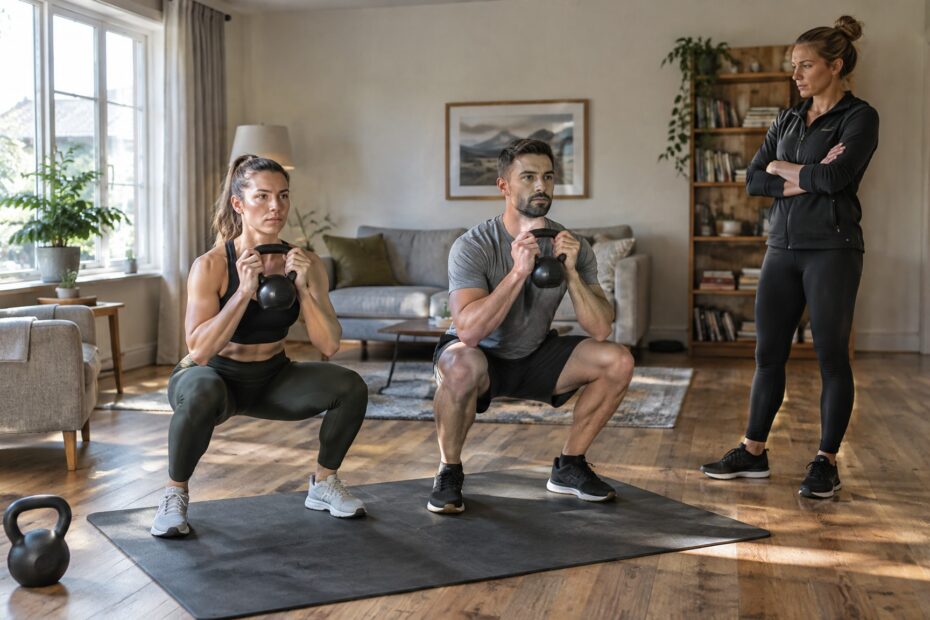
We come to you. That’s the idea behind couples personal training at home: one trainer, two of you, and a session in your living room, backyard or local park. You don’t need a gym membership, a second car or a babysitter.
Fitness Inside Out was founded in 2001 by Jacqueline Zonneveld and Jude Tarran. Our trainers go to clients’ homes, workplaces and local parks rather than asking couples to travel to a gym.
Why in-home personal training works for couples
Plenty of pages list 2-on-1 sessions as one more format on a menu. This is different. It’s built around two people who share a calendar, a household and (usually) a fridge, and who want to get fitter without one of them dragging the other along.
When you train with your partner at home, two things change. You hold each other to a booked time, and you cut out the travel that makes most gym plans fall over.
Those are the two reasons this article unpacks: shared accountability and plain old convenience. Both work best when you start together, so the next step is simple. Get in touch, tell us you’d like a first in-home 2-on-1 session as a couple, and we’ll take it from there.
How shared accountability keeps you both training
A solo plan is easy to renegotiate with yourself. A time you’ve booked with your partner and a trainer who’s about to knock on the door is much harder to talk your way out of.
Why training side by side keeps you both showing up
Most of us have signed up for a gym with good intentions and quietly stopped going. It’s common, and it’s rarely about willpower. Why gym memberships stall for busy people usually comes down to a plan that depends on you alone finding the time, the energy and the motivation on the same day.
A couples session removes that dependency. The slot is in both diaries, the trainer is coming either way, and skipping means changing plans for two people instead of one.
That pull is gentle, not guilt-driven. You’re not policing each other. You’re just both there.
A trainer also keeps things balanced. Friendly competition between partners is fun until one of you starts pushing the other, or keeping score at the dinner table. Your trainer sets the pace for each of you and keeps the session about your own progress, not who lifted more.
Keeping momentum when one of you falls off track
Life gets in the way, and a good plan expects that. Say one of you gets a sudden work trip and misses a few sessions. The partner at home doesn’t stall. They keep a short routine going, and the trainer adjusts their plan so their progress continues.
When the traveller gets back, the two of you agree with your trainer how to pick things up together. Nobody has to “catch up” in a rush or feel like they’ve ruined the block.
The same goes for a flat patch in motivation. If one of you is struggling, the other still has a session to look forward to, and the trainer can change the load or the focus so it feels doable again.
How a 2-person PT session works for couples at home
One trainer, two people, one session. The trick is that you’re not doing identical workouts side by side. Your trainer builds a single session with a shared structure and individual detail, so neither of you is held back or left standing around.
Training partners at different fitness levels in one session
Picture a typical case. One partner has trained consistently for years, while the other is returning after a long break. Here’s how a 2-person PT session handles that:
- Shared warm-up. You start together, which sets the tone and gets you both moving.
- Paired movements. You do the same exercise or a close variation, such as a squat pattern or a row, so you can work in the same space.
- Individual loading. The experienced partner lifts heavier or does more reps. The returning partner uses lighter weights or an easier version of the same move.
- Rest and range adjustments. One of you may need longer rests or a shallower range of motion. The trainer sets that for each person.
While one partner rests, the other is working, and the trainer moves between you. Nobody waits around, and nobody is made to feel they’re slowing the other down.
It won’t make you equal, and it isn’t meant to. The aim is that each of you trains at a level that suits you, in the same room, at the same time.
Balancing two goals without shortchanging either partner
Couples rarely want the same thing. One of you may want to lose weight, while the other wants to build strength. Both goals can sit in one session.
The weight-loss partner might do more circuit-style work with shorter rests, while the strength partner works through heavier sets. You share the warm-up and some movements, then branch off where your goals differ.
Each of you also tracks your own progress. That matters more than it sounds, because neither partner ends up feeling like the add-on to the other’s program. You each have your own targets, your own wins and your own plan.
This setup suits couples whose goals can live in the same hour. If your goals are so far apart that a shared session means constant compromise, it’s worth reading the fit check below.
Train with your partner at home, around two busy schedules
The biggest barrier to training isn’t motivation, it’s logistics. Getting two adults to the same place at the same time, on top of work and family, is where most plans quietly die. That’s the problem a mobile trainer solves.
No commute, one shared time slot
Your trainer comes to your home, a local park or your workplace. That means no driving to a gym, no parking, no meeting halfway and no sitting in traffic after a long day. If you’d like the detail on how a trainer that travels to you works, it’s worth a read before you book.
You also share one booked slot instead of juggling two separate ones. Whatever time you save on travel is time you spend actually training, and that’s the part you were after in the first place.
Fitting sessions around kids, shifts and travel
Real life comes with kids who need dinner, pets that need walking, rosters that change and work trips that appear overnight. A couple’s schedule is rarely tidy.
Two things handle most of those clashes. The first is a regular weekly slot that both of you can keep, such as an early morning before the kids are up, or an evening once they’re settled. Pick a time that works most weeks, rather than one that looks perfect on paper. If your hours are unpredictable, personal training built around busy professionals shows how we work with demanding diaries.
The second is a short home routine for the days between sessions. Your trainer can set one that you can do in your own space, together or on your own, when the week doesn’t line up. It keeps you moving without needing a full session.
A routine like this won’t replace your trainer-led session, and it isn’t designed to. It just stops one missed week from turning into a missed month.
Is in-home training for couples the right fit for you?
Training together suits many couples, but not all. It helps to be honest about what you each want before you book.
Shared 2-on-1 or separate 1-on-1 sessions
Shared 2-on-1 sessions suit couples with similar goals and aligned schedules. If you both want to get fitter, you can both make the same weekly slot, and you’re comfortable training in front of each other, this format works well.
Separate 1-on-1 sessions suit couples with very different goals. They’re also a better option if one partner wants privacy while they build confidence. Nothing says you have to train together to benefit from the same trainer team.
For the wider picture, our comparison of small group versus 1-on-1 sessions lays out how the formats differ. If you’re also weighing online or in-home training, that guide covers the trade-offs, and we also offer online sessions if travel is a regular part of your week.
Injury changes the question. If one of you is recovering, an exercise physiologist may be a better starting point than either a personal trainer option. Our guide to choosing an exercise physiologist or personal trainer for injury recovery can help you decide. We offer mobile exercise physiology, so the recovering partner can still be seen at home.
A couples session isn’t a treatment program. If either of you has an injury or health condition that needs clinical management, sort that out first.
What to prepare before your first session together
A little prep makes the first session far more useful. You don’t need to be fit, organised or even sure of your goals. Sit down together for ten minutes before you book and talk through four things.
First, each partner’s goals. Write them down separately, then compare. They don’t have to match, and it’s helpful if your trainer hears both.
Second, your health history and any injuries. Tell your trainer about old niggles, surgeries, medications and anything that makes a movement uncomfortable. Each partner does this for themselves, because what suits one of you may not suit the other.
Third, a regular weekly time. Choose a slot you can both realistically protect, then check it against work, school runs and any recurring commitments.
Fourth, a clear space. A cleared patch of lounge room, garage or backyard is often enough. If your home is tight, a nearby park works just as well, and your trainer can help you choose.
Choosing a couples package that fits your week
In-home personal training packages for couples are built around time and commitment. When you take one up, you’re committing to a shared weekly time that both of you protect. That’s the heart of it.
The package works because the slot is fixed in both diaries. Pick one that matches the week you actually have, not the week you wish you had. If one of you travels often or works rotating shifts, say so when you get in touch, so your trainer can plan around it.
Fitness for couples in Sydney and across our service areas
We train couples across Greater Sydney, the Central Coast NSW, Wollongong (Illawarra), Greater Melbourne and Brisbane. If you’re after fitness for couples in Sydney, our page for in-home personal trainers in Sydney is the best place to start.
Wherever you live, the process is the same. You tell us your goals, we match you with a trainer, and the trainer comes to you.
Ready to start? Get in touch and book a first in-home 2-on-1 session for the two of you.
Frequently asked questions
What happens if one of us can’t make a session?
The plan adjusts so the partner who’s there keeps progressing. If one of you is away for a few weeks, the other can follow a short routine, and you agree with your trainer how to pick things up together when you’re both back. Talk to your trainer about how missed sessions are handled when you book.
Can we train at a park instead of at home?
Yes. Your trainer can come to your home, a local park or your workplace. Pick whichever suits your space and schedule, and you can mix locations across the week.
What if we have different fitness levels or different goals?
One trainer runs a single session for both of you. You share the warm-up and some paired movements, then each of you gets your own loading, rest and range adjustments. Each partner tracks their own progress, so neither of you is held back or left waiting.
What if one of us is injured?
An injury may point to an exercise physiologist rather than a personal trainer, because recovery needs a different approach. We offer mobile exercise physiology, so the injured partner can be seen at home. Tell us about any injuries when you get in touch and we’ll point you to the right option.
Where can we book couples training?
We train couples across Greater Sydney, the Central Coast NSW, Wollongong (Illawarra), Greater Melbourne and Brisbane. Get in touch and ask for a first in-home 2-on-1 session. Sydney couples can also start on our Sydney personal trainers page.