
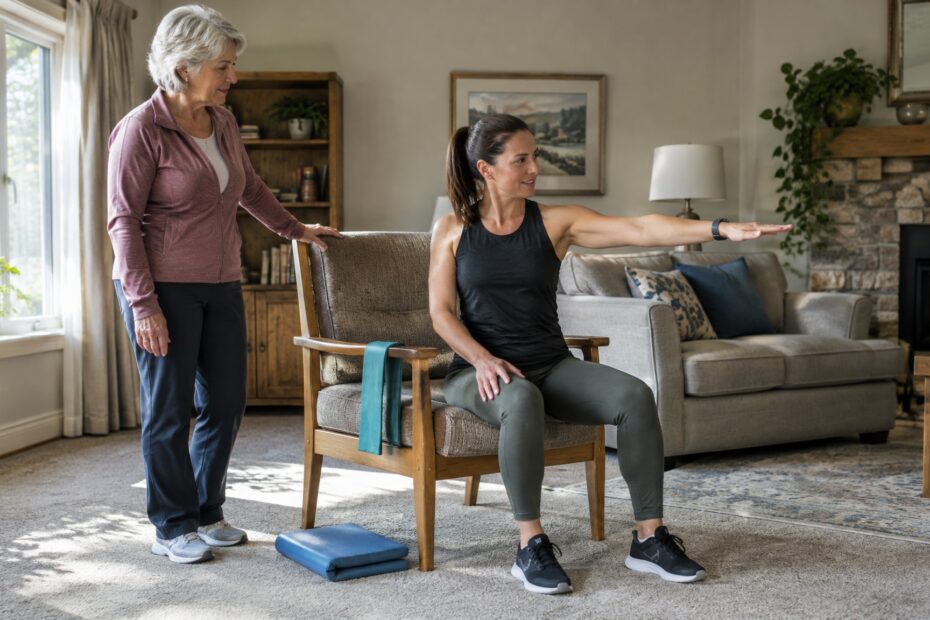
We come to you. That’s the whole idea behind in-home training, and for many people over 60 it removes the biggest hurdle before it appears: getting to a gym, finding parking, walking into a room full of strangers.
Finding the best personal trainer for over 60s at home still takes some care, though. This guide gives you a plain checklist to work through, whether you’re choosing for yourself or helping a parent. If you’re a little younger, our page on personal training for seniors over 50 at home covers the same ground for that bracket.
Why training at home suits people over 60
There’s no single best trainer for everyone. The right one is qualified, experienced with clients over 60, focused on balance and mobility, and easy to talk to. Everything below is a way of checking those four things.
Home training suits this age group for practical reasons. You train in the space where you actually move every day, so the stairs, the lounge-room chair and the kitchen step are part of the session. There’s no travel, no waiting for equipment and no pressure to keep up with the person on the next treadmill.
It also helps you stay active as you age without relying on willpower alone. A trainer arriving at your door on a set day is hard to put off, and plenty of people who have let a gym membership lapse find that appointment is what finally makes the habit stick. If that sounds familiar, read why gym memberships fail, and what works instead.
Fitness Inside Out was founded in 2001 by Jacqueline Zonneveld and Jude Tarran. Our trainers visit homes, workplaces and local parks, or work with clients live online, across Sydney, the Central Coast, Wollongong, Melbourne and Brisbane, and internationally.
Home training isn’t a magic fix, and it won’t suit someone who wants a crowd, a pool or a full weights floor. For most people over 60 who want to get stronger and steadier without joining a gym, it’s a very good fit.
Qualifications a personal trainer for over 60s should hold
A trainer working in your home is working without a gym’s front desk, staff or first-aid kit behind them. That makes paperwork matter more, not less, so you should ask to see it. Any good trainer will expect the question and be happy to answer.
Recognised qualifications and registration
In Australia, these are the credentials to look for:
- Certificate III or IV in Fitness. This is the basic qualification to coach people one-on-one.
- Fitness Australia Registered Exercise Professional (REP) status. This shows the trainer is registered and keeps their skills up to date.
- Accredited Exercise Physiologist (AEP) status through Exercise & Sports Science Australia (ESSA). This is the clinical qualification, and it matters when there’s a diagnosed condition.
An accredited exercise physiologist is the better first call when your parent has a diagnosed condition, such as heart disease, osteoporosis or diabetes, or is recovering from surgery or an injury. A personal trainer builds fitness and confidence; an exercise physiologist designs exercise as part of managing a health condition. Our guide to exercise physiologist or personal trainer: which one you need explains the difference in more detail.
A trainer can’t replace your GP, and no program should be started on the assumption that it can.
Experience with older clients and current safety checks
A qualification tells you a trainer has learned the basics. Experience tells you they’ve applied them to people in their 60s, 70s and beyond, whose joints, medications and confidence all differ. Ask how many older clients they train right now, and what those sessions look like.
Then check the safety essentials:
- Current first aid and CPR certificates.
- Public liability insurance.
- A police check, since they’ll be inside your home.
- A PAR-Q+ health questionnaire before the first session, so the trainer knows your history before they ask you to move.
Credentials differ from trainer to trainer, so ask whoever you’re considering, including our team, to confirm theirs in writing. A trainer who hesitates over that request has told you something useful.
Balance, falls prevention and mobility: what a personal trainer should cover
Falls are the risk that sits behind most of this. A fall prevention personal trainer treats balance and strength as the centre of the program, not a few extras added at the end of a session.
The evidence points the same way. Australian physical activity guidance for older adults (65 and over) calls for muscle-strengthening and balance activity alongside everyday movement, and the same principles suit people in their 60s who are starting out. Cochrane systematic reviews of exercise for preventing falls have found that exercise programs reduce falls among older people living in the community, and that programs which challenge balance are among the most consistently effective.
In plain words: if your trainer’s plan is mostly walking and light stretching, ask where the balance and strength work is.
Balance training built into every session
A good trainer measures before they train. Common baseline checks include:
- Timed Up and Go. You stand up from a chair, walk three metres, turn and sit back down while the trainer times you.
- 30-second chair stand. The trainer counts how many times you can stand fully up from a chair in 30 seconds.
- Four-stage balance test. You hold progressively harder foot positions, from feet together through to standing on one leg.
These let a trainer see your progress instead of guessing at it, and they give you numbers to look back on after a few weeks.
From one session to the next, falls prevention should look like steady, small progressions. One week you might practise standing with feet close together beside a bench. A few weeks on, you’re doing the same with your eyes tracking a moving target, or stepping over a low obstacle. The trainer stays within arm’s reach, makes each step only slightly harder than the last, and changes the plan the moment something feels unsteady.
Mobility training at home that carries over to daily life
Mobility training at home for seniors works best when it’s tied to the jobs you actually do. Sit-to-stand from your own lounge chair. Going up and down your own stairs. Getting down onto the floor and, just as important, getting back up again.
That last one deserves practice. Many people avoid the floor for years, then find they can’t get up after a fall or while playing with a grandchild. A trainer who rehearses it with you in a safe, controlled way is building a skill you’ll use.
Ask a trainer how each exercise links to something in your week. If they can’t answer, the exercise may not be doing much for you.
Communication style to look for in a personal trainer
You’ll spend a lot of time with this person, in your own home, so how they communicate matters as much as what they know. Training works when you trust the person asking you to try something new.
Signs a trainer listens, explains and adapts
Watch the first session closely. A trainer who suits you will:
- Explain why each exercise matters, in everyday words rather than jargon.
- Check in regularly on pain, breathlessness and confidence, and take your answer seriously.
- Adjust an exercise without making you feel judged or behind.
- Speak to you directly, even when a son or daughter is in the room.
That last point is easy to miss. If the trainer addresses your family while you sit there, they’re treating you as a patient instead of a client.
Good coaches also ask more than they tell at first. They want to know what you enjoy, what worries you and what you’d like to be able to do again, and they build the program around your answers.
Red flags to walk away from
Most trainers are well-meaning. Still, some habits mean it’s time to look elsewhere:
- They encourage you to push through pain. Discomfort from effort is normal; sharp or lingering pain is a signal to stop.
- They skip the health questions or the PAR-Q+, and go straight to exercises.
- They’re willing to start after a recent fall without clearance from your GP.
- They brush off your concerns with “you’ll be fine”.
- They talk over you, or finish your sentences.
- They promise fast results. Strength and balance build gradually, and anyone guaranteeing a quick transformation is selling something.
You don’t need to argue or explain if you pick up on one of these. You can simply decide this trainer isn’t the right fit and keep looking.
Setting up your home for safe training
Your home is the gym, so a few checks beforehand make sessions safer and calmer. Most of them take less than half an hour, and many are worth doing anyway.
Checking the space before the first session
Before the first visit, go through this list:
- Clear the walkways. Move cords, shoes, pet bowls and clutter away from the area where you’ll train.
- Sort the rugs. Remove loose rugs or secure them firmly so they can’t slide or curl.
- Find a sturdy chair. It should be stable, without wheels, and not too low or soft.
- Pick a stable surface for balance drills. A bench or a wall gives you something to hold.
- Wear supportive, non-slip footwear. Socks on timber floors are a common cause of slips.
- Keep a phone within reach. Charged and close by, not in another room.
Agree a plan, too. Decide what happens if someone feels unwell or has a fall: who gets called, where emergency contacts are written down and whether a neighbour or family member should know the session times.
Expect the trainer to walk the space with you on the first visit, before any training starts. They’ll spot things you’ve stopped noticing, such as the step between two rooms or a slippery tiled patch. If you’d like to see how this works in practice, here’s how a trainer who travels to you works.
In-home fitness for elderly parents: a family checklist
If you’re an adult child or partner helping with the search, your role is to support, not to run the process. In-home fitness for elderly parents only works when the parent wants it and owns it.
Here’s a simple way to share the load:
- Let your parent meet the trainer first. A short chat before any commitment lets them judge the fit for themselves.
- Ask for goals in your parent’s own words. Carrying the shopping, getting in and out of the car and playing with the grandchildren are the sort of goals that keep people going. Yours may be different from theirs, and theirs should win.
- Agree on one main contact. That might be your parent, or someone they nominate, so messages don’t get tangled.
- Check how progress is shared. Updates to the family should happen only with your parent’s consent.
The trainer should work with your parent directly. You can help with logistics, reminders and a cup of tea afterwards, but the decisions stay with the person doing the training.
Shortlist your trainer and book a first conversation
Once you have two or three names, a short call tells you more than any website. These six questions cover what matters most:
- How many clients over 60 do you train at the moment?
- How do you build and progress balance work?
- What do you do when pain flares up during a session?
- Do you liaise with a client’s GP when needed?
- How do you share progress with family, and only with the client’s consent?
- Can you confirm your qualifications, first aid, insurance and police check in writing?
Pay attention to how the answers sound, not just what they say. Clear, patient replies are a good sign. Vague or rushed ones are worth noting.
If you’d like to see what we offer, start with our over 50s personal training page, which covers one-on-one, two-on-one, small group and online sessions. When a parent has a diagnosed condition or a recent injury, ask about our mobile exercise physiology, which brings a clinical approach to the lounge room.
When you’re ready, talk to our team about an in-home trainer. Tell us where you live, what your goals are and what worries you, and we’ll talk it through with you.
Frequently asked questions
Do I need a doctor’s okay before starting with an in-home trainer?
A reputable trainer will ask you to complete a PAR-Q+ health questionnaire first, and it will flag whether you should see your GP. If you’ve had a recent fall, a new diagnosis or surgery, get clearance from your GP before starting. If you’re unsure, ask your doctor.
When should I choose an exercise physiologist instead of a personal trainer?
Choose an accredited exercise physiologist first when there’s a diagnosed condition or a recent injury that needs a clinical approach. A personal trainer is a good fit for building general strength, balance and confidence once you’re cleared to exercise. Some people use both over time.
Can my son or daughter sit in on sessions?
Yes, if you want them there. It can help in the first session or two, as long as the trainer speaks to you directly and you stay in charge of the goals. Progress updates should go to family only with your consent.
What do I need at home before the first session?
You need a clear walkway, a sturdy chair without wheels, a stable surface or wall for balance work, supportive non-slip shoes and a phone within reach. Loose rugs should be removed or secured. Ask your trainer what else they bring, and expect them to walk through the space with you first.
How quickly will I notice a difference?
It depends on where you start, how often you train and any health conditions, so be wary of anyone who promises a timeframe. A good trainer sets baseline tests such as the 30-second chair stand and Timed Up and Go, then repeats them so you can see your own progress.