
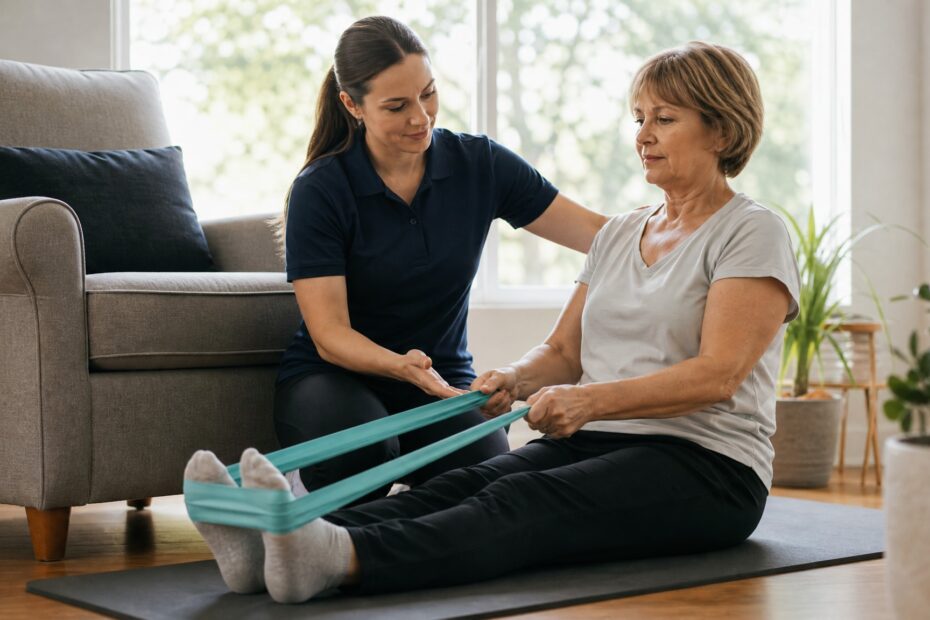
Recovering from injury or managing a chronic condition shouldn’t mean fighting Melbourne traffic to reach a clinic when you’re already in pain. A mobile exercise physiologist brings accredited allied health care straight to your home, local park, or workplace, so you can focus on getting better instead of getting there. Fitness Inside Out has delivered mobile health and fitness services across Australian capital cities since 2001, adapting clinical protocols for home environments for more than two decades so professional care fits around your actual life.
This approach removes the friction that causes people to quit rehab programs before they see results. You get evidence-based treatment from a university-qualified professional, no gym membership and no referral to a distant facility required.
What Is a Mobile Exercise Physiologist in Melbourne?
A mobile exercise physiologist is an Accredited Exercise Physiologist (AEP) who delivers clinical care outside clinic walls, built for people who need expert help but can’t easily get to a fixed location. Exercise Physiologists are four-year university qualified allied health professionals, accredited by Exercise & Sports Science Australia (ESSA). That’s what separates them from personal trainers: EPs are trained to treat clinical populations. The qualification lets them prescribe exercise as medicine for complex health conditions, working in the same allied health framework as physiotherapists and dietitians.
Accredited Experts Who Come to You
When you book an exercise physiologist that comes to you in Melbourne, you’re engaging a registered allied health professional bound by accreditation standards and ongoing education requirements. These practitioners hold provider numbers that enable Medicare rebates and NDIS funding, which sets them apart from unregulated fitness providers with no clinical training behind them. They bring portable assessment tools and adapt evidence-based protocols to suit your living space, so the standard of care holds whether you’re in a clinic or your lounge room.
Difference Between an EP and a Personal Trainer
Personal trainers are excellent for general fitness, strength conditioning, and weight loss in healthy populations, but they’re not qualified to manage acute injuries or complex chronic disease. If your main goal is metabolic health rather than injury rehab, weight loss support in Melbourne from a dedicated specialist might suit you better. An AEP has the pathology knowledge and clinical reasoning to work safely with conditions like heart failure, severe arthritis, or post-surgical complications, where the wrong loading could cause harm. A personal trainer Melbourne that comes to you is ideal for general conditioning. Only an accredited exercise physiologist can claim Medicare benefits and design programs for high-risk clinical presentations.
Conditions Managed Through At-Home Rehab Exercise in Melbourne
Mobile exercise physiology covers a broad range of health issues by bringing rehab into the environment where you actually live and move. At home rehab exercise in Melbourne works particularly well because your practitioner can watch and correct movement patterns in real-world settings rather than an artificial clinical room.
Musculoskeletal Injury Rehabilitation
Post-surgical recovery, tendon injuries, and chronic back pain respond well to graded exercise performed in your own space, using your own furniture and layout. Your therapist watches how you handle stairs, get out of chairs, and do household tasks, then prescribes movements that improve those specific functions. The exercises translate straight to daily life instead of staying abstract gym movements that feel disconnected from what you actually need. That’s what speeds up the return to normal activity.
Chronic Disease Management and Prevention
Medicare Chronic Disease Management plans let eligible patients access rebates for up to five allied health services per calendar year, including exercise physiology, for conditions like type 2 diabetes, cardiovascular disease, and osteoporosis. Managing these conditions takes consistent, long-term adherence to an exercise plan. That’s a lot easier when sessions happen at your doorstep instead of demanding travel during a symptom flare-up. Your mobile EP checks blood pressure, blood glucose response, and perceived exertion as you train, adjusting intensity to keep you safe while still giving your body enough stimulus to adapt.
Mental Health and Neurological Support
Exercise is a proven adjunct therapy for depression, anxiety, PTSD, and neurological conditions including Parkinson’s disease and stroke recovery. Attending appointments can feel like too much when your mental health is already stretched thin. Training at home cuts the sensory overload and social anxiety that come with public clinics, giving therapeutic work a safer setting to happen in. For neurological clients, practising balance and coordination in a familiar hallway or garden builds confidence that carries over to independent living, cutting fall risk far more than parallel bars in a sterile room ever could.
NDIS Exercise Physiologist Melbourne: Funding and Eligibility
Disability funding can be confusing to navigate, but understanding how NDIS exercise physiologist Melbourne services fit into your plan unlocks real support for functional improvement. Participants with Capacity Building budgets can use Improved Daily Living or Improved Health and Wellbeing funding to access accredited exercise physiology as a therapeutic intervention.
How NDIS Funding Covers Mobile EP Services
NDIS participants can use Capacity Building budgets for exercise physiology to build functional capacity and independence, as long as the service lines up with goals stated in their current plan. Our team handles the admin, booking sessions, writing progress reports, and preparing end-of-plan summaries for reviews, so your funding works efficiently toward outcomes you can measure. You can check specific eligibility criteria and registration details through our NDIS exercise support resources to confirm whether mobile EP suits your approved supports.
Capacity Building vs Core Supports
Exercise physiology sits under Capacity Building because it builds skills and resilience rather than providing ongoing personal care or respite, so it needs to show clear progress toward greater autonomy. Core Supports cover daily assistance that maintains where you’re at now. Your mobile EP, by contrast, actively works to reduce your future support needs through targeted strength, mobility, and self-management work. Understanding this distinction helps you make the case for the right funding at planning meetings, and it helps your therapist structure sessions to meet NDIS reporting requirements for skill development.
Benefits of Choosing an Exercise Physiologist That Comes to You
Getting care at home isn’t just about convenience. It changes the quality and relevance of your whole rehab experience. Mobile exercise physiology Melbourne services remove the barriers that normally stop people attending consistently, and consistent attendance is the single strongest predictor of a good outcome.
Overcoming Transport and Mobility Barriers
Melbourne’s sprawl, tight parking near medical precincts, and patchy public transport are genuine obstacles if you’re recovering from surgery or managing fatigue. When your therapist travels to you, those logistical headaches disappear, and you keep your energy for the actual therapeutic work instead of burning it on transit. That benefit compounds over weeks and months of treatment, because missed appointments from transport failures or bad weather become almost non-existent.
Training in Your Real-Life Environment
Clinical assessments in sterile rooms often miss safety hazards and functional limits that only show up in your actual living space. Your mobile EP sees how you navigate your specific staircase, your bathroom layout, your kitchen, then builds interventions around those exact challenges instead of generic movement patterns. Sessions often use household furniture and portable resistance bands to replicate clinical strength tests, so rehab keeps going safely whether or not you have gym access. That means the exercises you learn improve your ability to live independently in your own home, not just inside a controlled clinical bubble.
What to Expect From Your First In-Home Session
Your first consultation sets the foundation for everything that follows, combining a thorough clinical assessment with goal-setting you’re part of, done entirely at your doorstep. The session typically runs sixty minutes and covers your medical history, current medications, and specific functional limitations before any physical testing starts.
Clear a bit of floor space and wear something comfortable enough to move in. You don’t need to buy any equipment. Your practitioner brings portable monitoring devices, resistance tools, and educational materials, and will use your own chairs, walls, or steps where it makes sense for a safe exercise plan. Together you set realistic short-term targets and longer-term goals, giving you a clear roadmap for later sessions and something concrete to measure progress against. This first visit also decides whether you’d benefit from broader mobile exercise physiology services, or whether another allied health referral would serve you better right now.
Finding the Right Mobile EP Near Me in Greater Melbourne
Finding qualified in-home exercise physiology means checking both geographic availability and professional credentials, so you know you’re getting legitimate, rebate-eligible care. A search for “mobile EP near me” throws up plenty of results, but only ESSA-accredited practitioners with a valid Medicare provider number can deliver funded allied health services.
Service Areas Across Melbourne
Fitness Inside Out currently services Greater Melbourne, including the inner city, the eastern and southeastern corridors, the northern growth areas, and western regions out to Geelong. Coverage keeps expanding as practitioner availability grows, so it’s worth asking directly about your postcode even if your suburb isn’t listed online yet. If you’re on the outer fringe, you might see a longer wait or a travel surcharge, but we prioritise matching you with the nearest available accredited professional to keep your sessions consistent.
Verifying Accreditation and Experience
Always confirm ESSA accreditation through the national register before you book. It protects your eligibility for Medicare rebates, private health insurance claims, and NDIS funding. Ask any provider about their experience with your specific condition, how they adapt to mobile delivery, and their track record with NDIS plan review reporting if that applies to you. A genuine mobile EP will hand over their provider number without hesitation, talk honestly about their clinical scope, and point you elsewhere if your needs sit outside their expertise. Reading up on the benefits of mobile training helps you weigh up whether this delivery model suits your personality and learning style, on top of the clinical requirements.
Mobile exercise physiology doesn’t replace emergency care, acute surgical intervention, or intensive inpatient rehab for unstable conditions. It’s a bridge between hospital discharge and independent living, or ongoing management for stable chronic conditions where sticking with your exercise plan is what determines the long-term outcome.
Enquire today about mobile exercise physiology availability in your Melbourne suburb, or talk to our team about your NDIS and Medicare eligibility to see if this service pathway suits your current health needs.